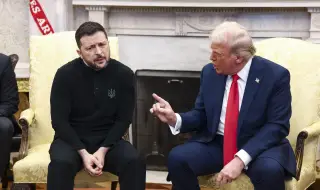
The Oval Office meeting between US President Donald Trump and Ukrainian President Volodymyr Zelensky in February last year was a diplomatic failure, BTA writes, citing the AP.
“Your country is in big trouble. You are not winning“, Trump said, sharply criticizing Zelensky in front of the world media. “You have no cards.“
Last year's scandal - three years after the war began - was more than a heated public exchange of remarks. The Ukrainian delegation was asked to leave the White House, and Washington temporarily stopped sharing intelligence with Kiev. In the months that followed, as Russia slowly but steadily advanced on the battlefield, Trump warmly welcomed Russian President Vladimir Putin to Alaska and seemed prepared to force Ukraine to accept an unprofitable peace deal, including giving up territory.
While Zelensky sat next to Trump, however, Ukrainian forces were preparing an operation that would demonstrate Ukraine’s ability and intent to take the war to Russian territory. Months later, drones secretly imported into Russia attacked Russian bombers and destroyed or damaged hundreds of millions of dollars’ worth of aircraft.
Since then, Kiev has stepped up its campaign of longer-range strikes on targets in Russia and in Moscow-occupied territories, increased weapons production, and attacked Russian air defenses as well as oil infrastructure and the warehouses of a major trading company, with the aim of bringing the fighting to Russian territory.
In a humiliating moment for Putin, Ukrainian drone strikes caused thick clouds of smoke to rise over St. Petersburg shortly before the opening of an international economic forum in June. Fears of Ukrainian attacks prompted Russian authorities to scale back the scale of a May 9 military parade to celebrate the victory over Nazi Germany. The strikes on oil refineries also led to a fuel crisis this summer.
Meeting Zelensky at the NATO summit in July, Trump said the Ukrainian leader had "handled the war very effectively." "We've actually built a good relationship," the US president added.
As the Ukrainian strikes have increased, Russian attacks have also intensified, and Kiev is facing serious difficulties in defending itself due to a shortage of American missiles for its Patriot air defense systems.
In the first six months of the year, 1,396 civilians were killed in Ukraine, according to UN data. Meanwhile, the world body said Russian authorities had reported 250 civilian deaths during the same period. On Monday, a strike that Ukraine said targeted an oil refinery in Russia killed 13 people, local authorities said.
While the Ukrainian strikes appear to have changed the way the war is perceived in Washington, it is still unclear whether they will succeed in getting Putin to negotiate.
The aim of the Ukrainian strikes is to undermine the notion that Russia can afford to “just let things happen,” said Jack Watling, a senior fellow at the London-based think tank RUSI.
Whether this strategy succeeds in getting Russia to negotiate depends on how much pressure Ukraine can apply. “It makes sense that above a certain threshold it works, but whether they can reach that threshold is an interesting question,” he said. He said this depends at least in part on factors beyond Kiev's control, such as continued financial support from Europe.
Most Ukrainian strikes are on targets within 200 kilometers, but the number of attacks at longer distances has increased significantly this year.
In July, Ukraine carried out three times as many such strikes as in January, according to data from the independent conflict monitoring organization ACLED. The repeated strikes deep into Russian territory have forced the Russian military to deploy its air defenses over a larger area.
Most of the Ukrainian strikes have targeted four main categories of targets, according to an Associated Press analysis of hundreds of Ukrainian attacks this year, based on statements by Russian officials, state media and the Ukrainian military.
After the war with Iran sent energy prices soaring and the United States eased sanctions on Russian oil, Kiev has stepped up attacks on oil infrastructure to deprive the Kremlin of fuel export revenue and so ordinary Russians can feel the effects of the war.
Ukraine has also targeted defense plants to weaken Russia's long-term ability to produce weapons, targeting air defenses to clear the way for its own weapons, and attacking warehouses of commercial companies.
As part of its campaign against oil infrastructure, Kiev said it had struck Russia's largest oil refinery, located more than 2,500 kilometers from Ukraine.
Kiev has also targeted defense plants. Among the targets was a navigation systems factory that has been attacked multiple times, including with Ukrainian "Flamingo" missiles.
In July and August, Ukraine struck warehouses of the Russian e-commerce company "Wildberries." Kiev claims the company helps supply the Russian military. Moscow denies this.
Many of the Ukrainian strikes on Russian air defenses and radar systems have targeted areas around the Russian-occupied Crimean peninsula and are often carried out by drones.
Major Robert “Magyar” Brody, the commander leading Ukraine’s drone war, told The Associated Press that the strikes in Crimea are also aimed at rendering the peninsula unusable as a base for Russian forces.
It is not always clear whether the Ukrainian attacks are effective, and some may have caused minimal or no damage. In May and June, Ukraine said it had struck several satellite, intelligence or electronic intelligence sites in Russia, but satellite images analyzed by the AP showed no significant damage.
However, Ukraine has one advantage that could help it weaken Russian air defenses and make its drone strikes more precise.
Ukraine has access to Elon Musk's Starlink satellite communications service, which allows its operators to control drones in real time over Russian-occupied Ukrainian territory. Russia is prohibited from using Starlink.
However, Russia is also developing its own version of Starlink and installed jamming systems that make it difficult to connect to satellite service, Brodsky said.
Even before the Oval Office meeting, Ukraine had begun investing heavily in new weapons, but that moment was a “serious warning signal“, said a European military official, who requested anonymity to discuss the situation on the front lines. It became clear that American support could be cut off “suddenly“.
In addition, Ukraine has stepped up its weapons production efforts, starting to produce an increasingly wide range of weapons in larger quantities, and the time for their development and production has been reduced from decades to years or even months.
However, Ukraine still cannot produce enough missiles to meet its needs. It also took time to develop systems that could hit targets with enough precision that Kiev would dare to use them to strike deep into Russia, Watling said.
While Ukraine has begun to overcome the navigation problems of its missiles, such as the Flamingo, these weapons are still not as accurate or stealthy as their Western counterparts. This often means launching hundreds of drones to overwhelm Russian air defenses and allow the missile to get through.
It’s an expensive and slow way to wage war, as Watling estimates that only 5 to 9 percent of Ukrainian weapons make it through Russian air defenses.
Even though Russian weapons are more powerful, Zelensky told a NATO summit in early July that Putin was “gradually losing control of the course” of the war. He said Ukraine had shifted the fighting from the front, where the offensive was stalled, to airstrikes on Russian targets.
At the meeting, Zelensky even joked when Trump asked him if he would accept peace talks in Moscow, as Putin had suggested. “There are a lot of Ukrainian drones in the air,” Zelensky replied. “It would be dangerous.“