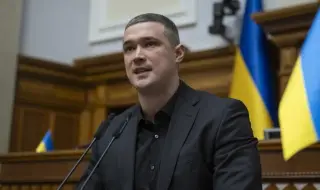
Former Ukrainian Defense Minister Mykhailo Fedorov called for wartime elections – the most serious domestic political challenge for President Volodymyr Zelensky since the Russian invasion.
The 35-year-old Fedorov has long been a close ally of the president and became Ukraine's youngest minister after Zelensky appointed him to his first government in 2019.
His unexpected dismissal as defense minister in July - just six months after his appointment - came after he promised sweeping reforms and gained popularity, but also clashed with senior military officials over disagreements over military strategy and the supply of the army with necessary equipment.
Fedorov's dismissal sparked rare wartime protests in the capital Kiev and other cities, mostly attended by young Ukrainians.
Fedorov is popular among the military, which uses drones, the use of which he has actively promoted since 2022, when he began war.
“We need to find a legal, safe and realistic mechanism that will allow Ukraine to fully restore its democratic process even in the conditions of a protracted war,“ Fedorov said on Tuesday evening.
In his sharpest criticism of Zelensky yet, he said Ukraine was facing a “systemic crisis in governance“, and criticized corruption during the war, without making specific accusations.
Yesterday, Zelensky dismissed a member of his administration without giving a reason after anti-corruption authorities said they had uncovered an alleged money laundering scheme. The president's office has not yet commented on Fedorov's criticism.
HOW DID HE RISE TO POWER?
Fedorov was born in Vasylivka – a city in southern Ukraine now under Russian occupation - and grew up in the nearby city of Zaporizhia, which is now subjected to daily Russian bombing and drone attacks.
As a young marketing specialist, he joined Zelensky, then a well-known TV presenter, and led his social media campaign that helped him win a landslide victory in the April 2019 elections.
FEDOROV CREATES “THE STATE IN A SMARTPHONE”
Then, at 28, Fedorov was appointed to Zelensky's first government as minister of digital transformation - a newly created position that gave him the power to push through technology-based reforms.
In an effort to eliminate the Soviet-era bureaucracy, his new ministry created an app called “Dia” - a word that means “action“ in Ukrainian. Billed as “the state in a smartphone“, the app allows Ukrainians to perform various administrative activities - from registering cars to concluding and terminating marriages.
WHAT IS ITS ROLE IN THE “STARLINK“ SYSTEM AND DRONES?
When Russia launched its full-scale invasion of Ukraine in 2022, Fedorov publicly called on “SpaceX“ owner Elon Musk to activate the “Starlink“ satellite internet service over Ukraine, which Musk did immediately.
The Ukrainian army currently uses tens of thousands of “Starlink“ devices, and commanders describe them as vital for battlefield communications. In February of this year, Fedorov worked with “Starlink“ to block unauthorized use of the service by Russia.
At the beginning of the war, he also supported the creation of a “drone army“, becoming one of the early proponents of the technology that subsequently began to play a leading role on the battlefield.
His department created a system that awards points to Ukrainian servicemen when they confirm with video footage strikes on Russian soldiers and military equipment. The points earned can be used to purchase weapons, including drones.
Thus, his ministry has amassed a large amount of battlefield data, which Fedorov has presented as a “trump card” that Ukraine can use in negotiations with allies for additional military aid.
WHAT DID FEDOROV DO AS DEFENSE MINISTER?
After being appointed defense minister in January 2026, Fedorov promised a comprehensive reform of the vast institution based on data analysis. The ministry has been rocked by scandals related to corruption and mismanagement throughout the war.
He presented his vision for achieving victory, which envisaged Russia suffering 50,000 killed and wounded per month, neutralizing Russian air attacks, and weakening the Russian economy.
However, he did not present promised proposals to reform Ukraine's military recruitment system and make it fairer.
Fedorov announced a reform of service contracts in the army, which numbers about one million people, and promised a pay increase, especially for infantry. But servicemen said the proposals favored new recruits.
People who volunteered for the army earlier in the war still have few options to leave unless they are seriously injured.
DISMISSAL AND PROTESTS
Fedorov was abruptly dismissed from his post in mid-July as part of a campaign for more senior government officials. The decision sparked protests, with thousands of people taking to the streets of Kiev and other Ukrainian cities. They demanded that Fedorov be reinstated and that the commander of the armed forces, Oleksandr Syrsky, be released. Critics argued that his preferred infantry-heavy approach had led to heavy casualties among Ukrainian forces.
Zelensky subsequently replaced Syrsky with a younger general, but did not reinstate Fedorov, instead nominating the head of Ukraine’s Security Service, Yevgeny Khmara, as the new defense minister.
On the eve of a parliamentary vote to confirm Khmara, Fedorov called for elections. This was in a statement that contained the sharpest criticism of Zelensky since the start of the war from someone who was in the president’s closest circle.
Translated from English by Elena Indzheva, BTA