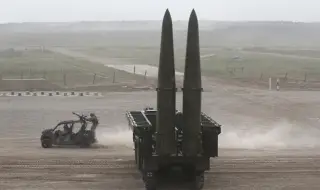
Russian forces have launched a massive combined drone and missile strike against Ukraine, continuing their practice of building up ballistic and cruise missiles in recent days to amass enough stockpiles for large-scale attacks that could cause significant civilian casualties.
The Russian ballistic missile strikes have damaged residential buildings, a children's hospital, a school, industrial facilities, and energy infrastructure, the Institute for the Study of War (ISW) reports.
On August 20, the Ukrainian Air Force reported that Russian forces had fired an unspecified number of ballistic and quasi-ballistic missiles; surface-to-surface cruise missiles; and "air-to-ground"; ship-launched cruise missiles; "Banderol" type unmanned munitions; "Shahed" type attack drones; as well as "Gerbera" and "Parody" type decoy drones on the night of 19-20 August.
The Ukrainian Air Force reported that Ukrainian forces had shot down the majority of drones and cruise missiles, that unspecified air targets had hit 28 locations, and that debris had fallen in two locations.
Ukrainian forces had intercepted about 88.6 percent of Russian cruise missiles, and Ukrainian President Volodymyr Zelensky reported on 20 August that Ukrainian forces had intercepted 93 percent of cruise missiles overall.
Since 11 August, the Ukrainian Air Force has stopped regularly reporting the number of Russian ballistic missiles fired and intercepted.
Russian ballistic missile strikes have damaged residential buildings, a children's hospital, a school, industrial facilities, and energy infrastructure in the city of Kyiv and the Kyiv region, killing at least 12 people in the capital alone and injuring at least 40 wounded.
Ukrainian Prime Minister Serhiy Koretsky reported that Russian strikes on the city of Kiev lasted almost nine hours, and noted that Russian forces also struck Red Cross facilities and food warehouses near Boryspil, Kiev region.
Ukrainian officials also reported that Russian forces struck civilian, critical and energy infrastructure in the Chernihiv, Cherkasy, Odessa and Mykolaiv regions, a gas station in Kharkiv region and logistics infrastructure in Zhytomyr region.
Russia continues to create conditions for expanding its strike complexes with North Korean missiles, including modernized KN-30 ballistic missiles.
The Main Directorate of Military Intelligence (GUR) of Ukraine confirmed on August 20 that as of July 2026, North Korea had transferred to Russia about 50 ballistic missiles of the types KN-23, KN-24 and KN-30 (Hwansong-11C).
The KN-30 is a modernized version of the KN-23 ballistic missile and can carry a warhead weighing up to 2,500 kilograms.
ISW has seen no evidence that Russian forces are using the KN-30 against Ukraine.
The GUR added that Russia has begun deploying six launchers for North Korean missiles in the Voronezh region and that the launchers will be able to launch a total of 120 missiles.
The North Korean missiles could strike the Sumy, Kharkiv, Chernihiv, Poltava, Kyiv, Dnepropetrovsk and Zaporizhia regions of the Voronezh region.
On August 20, Russian drones entered the airspace of Moldova and Romania, and a Russian naval drone was destroyed near a Romanian oil platform. of natural gas.
These incidents show that the Kremlin has accepted the risk that its war against Ukraine will harm other countries, including NATO member states.
The Kremlin will likely seek to have a significant number of Russian veterans of the war in Ukraine elected to the Russian State Duma in the September 2026 elections, particularly as members of the "United Russia" party.
This strategy is part of a concerted effort to militarize Russian society and rally the pro-war and ultranationalist elite.
The Russian government continues to respond inadequately to the gasoline shortage and appears to be focusing on mitigation strategies and temporary solutions rather than addressing the problem directly.
Neither the Kremlin nor Russian military bloggers seem to believe that Russia will be able to completely thwart Ukrainian strikes in the near future. future.
On the night of August 19-20, Ukrainian forces continued their campaign of long-range strikes against Russian oil infrastructure and military targets.
Russian forces have recently advanced into the northern part of Sumy Oblast and towards Pokrovsk.