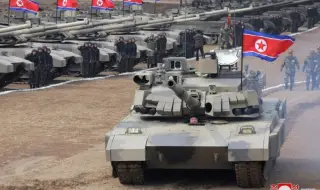
North Korea has deployed drone operators in the Kursk region to support the Russian war in Ukraine, which will allow North Korean forces to acquire valuable tactical and technological skills crucial to modern warfare.
The deputy head of the Main Military Intelligence Directorate (GUR) of Ukraine, Major General Vadim Skibitsky, announced on August 21 that among the 8,500 new North Korean soldiers already operating mainly in the Kursk region, there is also a 400-person unit specializing in operating drones, whose operators could monitor and strike targets in Ukraine.
Skibitsky added that the deployed North Korean troops will not fight on the territory of Ukraine, but will reinforce Russia's rear areas and free up Russian personnel.
Skibitsky reported that North Korea has so far deployed or replaced about 25,000 soldiers within the Russian army and that Russian President Vladimir Putin may ask North Korean dictator and General Secretary of the Workers' Party of Korea Kim Jong-un for up to 50,000 additional North Korean soldiers in September 2026.
ISW previously noted evidence that North Korean forces used strike drones and reconnaissance drones alongside Russian troops in the Kursk region during their first deployment in Russia in August and October 2025, which provided North Korean forces with valuable tactical and technical experience.
Ukrainian forces are adapting their tactics and developing technological national solutions to strike Russian ballistic missile launchers and jet-powered drones, thus circumventing the need for foreign material assistance amid a global shortage of air defense interceptors.
Sources told the "Financial Times" (FT) on August 21 that Ukraine is seeking approval to use drones equipped with "Starlink" to strike Russian ballistic missile launchers at a range of up to 200 kilometers inside Russian territory.
The permission to access "Starlink" over geographically defined segments of Russian territory would allow Ukrainian forces to deliver more precise strikes against Russian mobile ground-based ballistic missile launchers, given Ukraine's integration of Starlink-equipped drones during the medium-range strike campaign against Russian logistics in occupied Ukraine.
In the summer of 2026, Russia's combined drone and missile strikes underwent a shift, beginning to rely on ballistic and quasi-ballistic missiles to take advantage of Ukraine's shortage of Patriot systems and ballistic missile interceptors.
Ukraine's request for limited use of Starlink demonstrates an alternative approach to countering Russian ground-based ballistic missiles that does not require the actual delivery of interceptor missiles by the United States and other Ukrainian partners.
Reliable satellite access over Russian territory could also allow Ukraine to effectively and accurately target mobile ground-based missile launchers in Russia and compensate for a broader shortage of surface-to-air missiles.
A senior Russian official reiterated that the Kremlin remains unwilling to engage in any substantive negotiations to end the war in Ukraine.
Russian Deputy Foreign Minister Sergei Ryabkov said on August 21 that Russia would only accept a peace proposal that is consistent with Russian President Vladimir Putin's military goals and reflects "the realities on the ground."
Putin's maximalist and oft-repeated military goals include the complete Ukraine's surrender, the establishment of a pro-Russian puppet government in Kiev, as well as severe restrictions on the Ukrainian armed forces and Ukraine's aspirations for NATO membership.
Ryabkov's statement confirms Putin's determination to continue the war in Ukraine despite mounting economic and military losses.
Volodymyr Zelensky has repeatedly reaffirmed his commitment to peace negotiations and his willingness to make significant compromises to end the war.