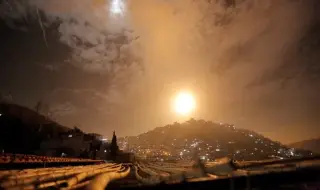
Early Tuesday morning, Israel attacked an air base in northwestern Syria and said that these actions were taken to prevent the deployment of Turkish troops there, the Associated Press reported, quoted by BTA.
Ankara, which maintains close ties with the Syrian government and supports the Syrian army, has highly strained relations with Israel. Each of the two warring parties is trying to limit the other's influence in neighboring Syria.
The attack on the Abu Duhur base, located in the northwestern province of Idlib, resulted in eight strikes on its runway, but there were no damages or casualties, Syrian state television reported. Syrian Foreign Minister Assad al-Shibani told reporters in Damascus that his country condemned "Israeli aggression" and added that the attack constituted an “unprovoked provocation, a violation of Syrian sovereignty and a direct threat to regional and global security“.
Israeli Prime Minister Benjamin Netanyahu's office said Israel attacked the base because Syria was “on the verge of violating the agreed security status quo“ by allowing Turkish forces to be stationed there.
“Israel has repeatedly warned Syria that the deployment would threaten Israeli security. "Syria chose to ignore these warnings," the statement said.
The Turkish Foreign Ministry condemned the attack and called on "the international community to take a more determined stance to stop the escalating Israeli aggression in Syria and to ensure that these actions, which constitute a clear disregard for international law, are held accountable."
The British-based Syrian Observatory for Human Rights, a non-governmental organization, claims that the base was until recently used by foreign fighters until they were told to leave. According to the Center, Turkey, one of the main supporters of the Syrian government, is restoring the base, which previously stood unused during the bloody civil conflict in Syria, which claimed hundreds of thousands of lives.
On Wednesday, Ash Shibani said in an interview with the publication “Axios“ that he had made it clear to Israel that there were no plans for a Turkish military base in Abu Duhur, Reuters reported.
He added that Turkish officers had indeed visited the site a few days before the strike, but stressed that the visit took place within the framework of “ongoing cooperation in areas such as training and exchange of experience“.
On Thursday, the Turkish Ministry of Defense said that there had been no Turkish delegation at the base either before or after the strike and that Ankara would continue to help Syria develop its own military capabilities and infrastructure. "It is essential for peace and stability in Syria and the region that Israel cease its reckless attacks and abide by international law," the ministry said.
According to Reuters sources, the issue of deploying Turkish troops to Syria was discussed during an unusual phone call between Ash Shibani and the head of Israel's Mossad intelligence service, Roman Hoffman, on August 14.
THE U.S. POSITION
Tom Barak, the U.S. ambassador to Turkey and President Donald Trump's special envoy for Syria, wrote in Ex that Washington "is seriously concerned that the news of Israeli strikes on the Abu Dhuhur base has been confirmed, as they constitute an unnecessary escalation that does not contribute to strengthening regional security."
The interim government Syrian President Ahmed al-Sharaa "neither pursues an aggressive policy nor harbors proxy forces on his soil" and has repeatedly made it clear that he prefers to reduce tensions with Israel, the diplomat added.
According to him, the United States will continue to help promote dialogue.
Countries in the region such as Qatar, Egypt and Saudi Arabia have also come out with positions condemning the strikes.
THE BACKGROUND TO THE CONFLICT
Since the government of President Bashar al-Assad fell from power in December 2024 after rebel forces entered Damascus, tensions between Turkey and Israel have continued to rise.
After the overthrow of the regime, Israel launched hundreds of strikes throughout Syria, the main target of which were Syrian army assets that Israel did not want to fall into the hands of the new government. The Israeli army took control of a buffer zone along the border that UN peacekeepers had previously patrolled, and continues to occupy it to this day.
The new government in Damascus says it does not want a confrontation with Israel, but Israel remains suspicious of the new government of the Islamist rebels.
So far, negotiations, which have been underway for a year under the auspices of the United States to conclude a security agreement, have not led to a significant diplomatic breakthrough.
KATZ WARNS ERDOGAN
In an article in Ex, Israeli Defense Minister Israel Katz warned Turkish President Recep Tayyip Erdogan “not to involve Turkey in dangerous adventures in Syria and not to test Israel's resolve to defend itself“, Reuters reported.
NATO Turkey, which has a 900-kilometer common border with Syria, was a major player in the 13-year civil war, during which it supported anti-government forces and on several occasions sent its troops to Syrian soil against Kurdish groups, which Ankara considers a threat to Turkish national security.
For Israel, concerns about Iranian influence under Assad have given way to concerns about Turkey's role after he was overthrown by fighters from Shaaraa, a former al-Qaeda commander who later developed warm relations with Washington, Reuters notes.
Among the main reasons for concern for Israel are the extremist past of the new rulers in Damascus and the protection of the Druze minority, who live on both sides of the Israeli-Syrian border and are a traditional ally of Israel.
These concerns also have a very distinct public and media resonance in Israel on the eve of the upcoming elections there on October 27. Sociological surveys so far indicate that Netanyahu could lose, not least because of accusations against him of security failures surrounding the “Hamas” attack. on October 7, 2023.
TURKEY ASKS INTERPOL TO ISSUE AN ARREST WARRANT FOR NETANYAHU
Turkey has asked Interpol to issue a red notice for Netanyahu's arrest, the pro-government newspaper „Yeni Şafak“ reported.
„Turkey has started the process of issuing an Interpol red notice for the arrest of those responsible for the attack on the „Global Sumud“ (humanitarian) flotilla, among whom is Israeli Prime Minister Benjamin Netanyahu,“ said Turkish Justice Minister Akan Gurlek, quoted by Turkish media.
The request has been submitted to the Turkish Foreign Ministry.
The flotilla sailing to Gaza was stopped in May this year by Israeli forces amid heightened tensions over humanitarian access to the enclave. The aim of the activists on board was to draw attention to the humanitarian situation in the Gaza Strip by breaking the Israeli-imposed naval blockade.
In addition to Netanyahu, Turkey has requested international arrest warrants for several other individuals, including another Israeli citizen, Afek Moskovich. In a post on his Ex profile, the minister stated that the search with a red notice was requested in accordance with the arrest warrants issued by the Turkish authorities on July 14 for the two on charges of “genocide“.
Gürlek added that Netanyahu and Moskovich are indicted for “crimes against humanity“, “genocide“, “intentional bodily harm“, “torture“, “damage to property“, “aggravated robbery“, “hijacking of means of transport“, “unlawful deprivation of liberty“ etc.
“We in no way accept the understanding that the Netanyahu government, which is pursuing a policy of genocide in Gaza, is inviolable and cannot be held accountable“, the Turkish minister added.