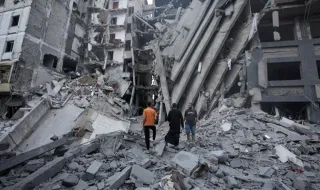
Living in the rubble: Estimates suggest more than 80 percent of Gaza's houses have been destroyed or damaged, with no organized recovery in sight. So people are forced to improvise.
In the Al-Shati neighborhood in western Gaza City, most of the houses have been destroyed, including Alaa Judeh's. The 38-year-old walks past the gray concrete rubble of his destroyed house, climbs a few steps, and enters through the door of a wooden shack.
“This is the bedroom, and there's a bathroom,“ Alaa explains. “In the temporary shelters there is nothing like this - there is no privacy, no security and no kitchen&rdquo, he tells an ARD reporter.
Alaa shows him around the shack. Curtains separate the bedroom, bathroom and living room with a handmade kitchenette. LED tubes illuminate the room. Currently, his family has electricity. They boil water for tea on a gas burner.
Lack of equipment and shortage of building materials
The road to their own home was not easy. It took them about a month to tidy up this improvised shelter. First, they had to remove the waste, for which, however, they lacked the appropriate equipment, says Alaa. “So we came up with the idea of not hauling away the rubble, but piling it up and building on it.“
Down the street, Alaa and his neighbors have built a storefront out of wooden slats and plastic sheeting. Alaa is a construction worker, and they salvaged the wood and nails from the rubble of his destroyed house, he says.
Building materials are scarce in Gaza. Israeli authorities are not allowing them to be imported - they fear that the wood, cement and other materials will fall into the hands of Hamas.
Alaa's neighbor, Abu Ahmed, praises his ability to improvise. “Alaa has managed to build a life from nothing, and in doing so, he is showing the whole world: the Palestinian people have the right to a decent life.“
No progress - the US peace plan for Gaza
According to estimates, over 80 percent of the buildings in Gaza have been destroyed or damaged. No reconstruction is in sight: the implementation of the so-called US peace plan for Gaza is stalled. The disarmament of Hamas and the withdrawal of the Israeli army are still not a fact.
Alaa Judeh does not know how much longer he will have to live in this wooden shack - among the ruins. But he accepts things as they are. “For reconstruction, we need determination, perseverance and new, unconventional ideas. We need to unite young people and use their abilities.“
Alaa Judeh's wooden shack is probably not a model for each of the more than two million people in Gaza. But it is an example that inspires courage, the ARD report from Gaza also says.