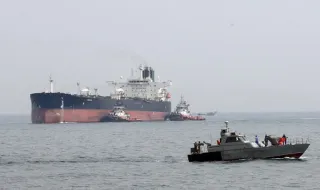
Mediators in the war with Iran are stepping up diplomatic efforts to restore normal shipping through the Strait of Hormuz after Tehran agreed to draw up a list of conditions for opening the strategic sea route, reports "Reuters".
Qatari Prime Minister and Foreign Minister Sheikh Mohammed bin Abdulrahman Al Thani visited Tehran on Thursday and held talks with senior Iranian officials.
During the meetings, he stressed the need to restore the pre-war regime of free navigation through the strait.
Al Thani said he was stressed to the Iranian authorities "the importance of respecting freedom of navigation in the Strait of Hormuz in accordance with international law".
The diplomatic initiative comes at a time when the United States has practically withdrawn from direct negotiations with Tehran and the administration of President Donald Trump has focused its efforts on increased economic pressure and new sanctions against Iran.
Iranian Foreign Minister Abbas Araghchi described the talks with the Qatari prime minister as "creative" and again called on Washington to end military and economic pressure and return to negotiations.
"Returning diplomacy to the right track is not impossible. "It depends on the US understanding one simple fact: pressure does not work," Araghchi said.
The Iranian Foreign Ministry separately condemned the new US economic sanctions announced on Monday, calling them "state terrorism".
Tehran also called on other countries not to join the restrictions, which Iranian authorities said would amount to "complicity in imposing the illegitimate will of a state" on others.
Iran prepares list of conditions for opening the Strait of Hormuz
The Secretary of Iran's Supreme National Security Council, Mohsen Rezaei, announced on Thursday that Tehran is preparing a list of conditions under which the Strait of Hormuz can be opened to normal international shipping.
Rezaei said in an interview with Al-Manar TV that Iran has already reached an agreement with Oman to create a shipping corridor through the strait.
Parts of the route will pass through Omani, and others through Iranian territorial waters. The ships will be able to use a designated central channel if the United States accepts Tehran's terms.
It is not clear exactly what the new Iranian demands will be.
In the previous stages of the negotiations, Tehran demanded an end to the US blockade of Iranian ports, the lifting of sanctions, and compensation for the damage caused in the war.
It is not yet known whether Iran intends to change these conditions so that they become acceptable to Washington.
In recent weeks, direct contacts between the United States and Iran have practically ceased, and the main diplomatic activity is conducted through Qatar, Oman, and Pakistan.
Qatar and Pakistan also played a key role in negotiating a memorandum in June that led to a temporary ceasefire. However, the agreement quickly fell apart due to disagreements between Washington and Tehran over the shipping regime through the Strait of Hormuz.
Trump declared the memorandum closed on July 8, and the US administration subsequently intensified its campaign of economic pressure on Iran.
The Strait of Hormuz has become Tehran's main trump card
The Strait of Hormuz is one of the most important strategic sea routes in the world. Before the war began on February 28, about 20% of the world's oil supplies passed through it, as well as a significant part of the trade in liquefied natural gas.
After the start of the US and Israeli strikes on Iran, Tehran warned that it could attack ships that pass through the strait without its permission.
The threats led to a sharp drop in maritime traffic and a rise in oil prices, with control over shipping becoming one of Iran's main tools for pressure in negotiations.
The United States insists that the Strait of Hormuz remains a free international waterway and rejects the possibility of Tehran unilaterally determining who can pass through it.
Previous proposals discussed between Iran and Oman envisaged that Tehran would be given a certain role in controlling ships entering the Persian Gulf - an idea that Washington has so far rejected.
U.S. claim to have rammed the strait
The US military command, meanwhile, said that US forces had cleared sea mines laid months ago in the Strait of Hormuz by the Islamic Revolutionary Guard Corps.
"Ultimately, international shipping lanes are open today and momentum is building," said Admiral Brad Cooper, commander of US Central Command.
He said US forces had helped about 1,500 commercial ships carrying nearly 750 million barrels of crude oil pass through the strait in recent months.
President Donald Trump has repeatedly said that the Strait of Hormuz is open.
However, many shipowners continue to avoid the route because of Iranian threats and the high risk to vessels.
Shipping tracking systems estimate actual activity in recent weeks at only about 5-15% of normal level.
Preliminary data from the analytics company Kpler showed that only seven cargo ships passed through the Strait of Hormuz on Thursday.
A day earlier, there were 17, and the average number for the previous ten days is about 15.
Before the war, an average of about 125 vessels passed through the strait daily.
The data does not give a completely accurate picture, as some ships turn off their automatic identification systems (AIS) due to security concerns.
Gulf states seek routes around the Strait of Hormuz
The ongoing disruption of shipping is already causing Gulf states to invest billions of dollars in infrastructure to reduce their dependence on the Strait of Hormuz.
Oil pipelines, ports and land transport links are being expanded, that allow some energy supplies to be redirected to the Red Sea or to ports outside the Persian Gulf.
Saudi Arabia is redirecting some exports to its Red Sea ports, while the United Arab Emirates is using ports on its east coast, including Fujairah, which is outside the Strait of Hormuz.
However, the capacity of these alternative routes remains smaller than the volumes that passed through Hormuz before the war.
Oil prices remained relatively stable on Friday and were heading for a weekly decline, which analysts attribute both to limited signs of increasing flows through the strait and to the fact that producers and traders are gradually adjusting to the prolonged crisis.
After six months of war, diplomatic efforts are increasingly focused not on a comprehensive political agreement between the United States and Iran, but on a more limited but economically critical goal - the restoration of normal shipping through the Strait of Hormuz.