The UN World Food Program (WFP) announced that it is halving its aid to the West Bank due to a lack of funding, Agence France-Presse reported, quoted by BTA.
„The WFP has been forced to halve the number of people it is assisting in the West Bank. And this comes at a time when food needs in the West Bank have more than doubled compared to two years ago,” Sean Hughes, the organization’s representative in the Palestinian territories, told reporters in Geneva.
“Our funds are running out, which means that from today, some 200,000 people will no longer have access to life-saving assistance,” he added.
WFP estimates that 900,000 people face food insecurity in the West Bank.
“The renewed settler violence and population displacement are disrupting food security, exacerbating hunger and plunging families deeper into crisis,” the organization said in a statement.
Israel has occupied the West Bank, where the government of The Palestinian Authority, and over 500,000 Israelis live in settlements that are illegal under international law, alongside three million Palestinians.
So far, WFP assistance has reached 400,000 of the most vulnerable people there.
“WFP's latest food security analysis shows that more than a third of the population still struggles to meet their basic needs and afford enough food,“ Hughes stressed.
“Food may be available in the markets, but people simply cannot afford it,“ he noted.
WFP, in collaboration with its partners, is supporting families in the West Bank through financial and food assistance.
Lack of funding for aid in Gaza
Lack of funding threatens and WFP operations in Gaza, where it supports 1.5 million people, including one million who receive monthly food assistance, the statement said.
In July, the agency already cut financial assistance to 375,000 people in Gaza by 40 percent and warned that further cuts would be inevitable without additional funding.
In Gaza, two-thirds of the population is facing “crisis or emergency levels of hunger”, Hughes said.
“If humanitarian food assistance is not sustained, up to 90 percent of the population will face high levels of acute food insecurity by the end of this year,” he said.
WFP says it needs $386 million over the next six months to help nearly two million people living in precarious food environment in Gaza and the West Bank.
The situation on the ground in Gaza “remains appalling and extremely volatile“, Hughes said.
“Airstrikes and bombing have intensified in recent days, including again this morning. WFP warehouses were hit and damaged in multiple areas, especially near the “Yellow Line“, which separates the Israeli-occupied area from the rest of the territory,“ he said.
Only 3 percent of the arable land in the Gaza Strip remains intact and accessible to farmers, a critical situation, mainly due to the expansion of military restricted zones, the UN recently warned.
WHO warns of disease risks
The approach of the rainy season raises concerns about worsening health risks in the Gaza Strip, where the majority of the population still lives in conditions of insecurity, the World Health Organization (WHO) has warned.
“Although we are still not able to provide the population with the minimum necessary quantities of water, water quality and pollution remain a major problem,“ he told journalists in Geneva from Gaza, WHO Representative for the occupied Palestinian territory Reinhilde Van de Weerd.
Between January and August this year, more than 6,700 water samples were analyzed. Microbiological contamination has almost tripled, rising from less than 6 percent in January to more than 18 percent in August, according to WHO data.
This has led to a “significant increase in cases of acute watery diarrhea over the same period: the number has almost doubled, rising from approximately 27,000 in March to more than 48,000 in August,” Van de Weerd said.
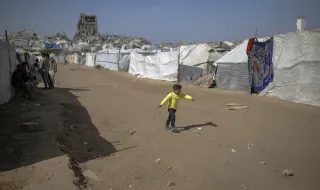
“Now the rainy season and winter are fast approaching. The majority of Gazans still live in extremely crowded settlements, in makeshift tents, with piles of garbage reaching several meters high,” she warned.
She said the approaching rains would flood overcrowded settlements, and sewage, garbage and contaminated water "would spread into the very spaces where residents sleep, cook and care for their children", exacerbating the risk of waterborne diseases.
This is likely to breed pests, mosquitoes, mold and bacteria, while Gaza's already overburdened health system is unable to cope with new outbreaks of disease.
“We urgently need more permanent housing, sustainable water supplies - both in quantity and quality - and waste management systems”, as well as laboratory supplies to quickly confirm the causes of diseases, the official stressed.
However, she pointed out that basic laboratory and diagnostic supplies, including reagents needed for analysis, are still not available. allowed for import into the country.
Therefore, the WHO calls on the Israeli authorities to “allow unhindered and expedited large-scale import of essential medicines and supplies“.