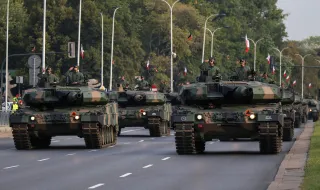
Poland plans to establish production and maintenance of South Korean K2 tanks on its territory by 2028. However, the plans may be delayed due to disagreements between the Polish defense industry and South Korean manufacturer Hyundai Rotem, reports the Polish publication Rzeczpospolita, reports News.bg.
Although the cooperation between the Polish Armament Group (PGZ) and Hyundai Rotem is officially assessed positively, according to the publication, serious contradictions remain behind the scenes.
The Polish armed forces currently have over 200 K2 tanks. The first 180 vehicles were delivered under a contract from 2022. On August 1, 2025, Poland and South Korea signed a new agreement for another 180 tanks for the period 2026-2030.
Of these, 116 vehicles in the K2GF version should be delivered in 2026-2027, and another 64 K2PL tanks - in 2028-2030. The final assembly of 61 of the K2PL tanks is planned to be carried out at the Bumar-Łabędy plant in Poland.
Poland wants technology transfer
The second contract is different from the initial purchase, as Warsaw expects not only finished tanks, but also the acquisition of technology and production experience.
In December 2025, the Polish Armaments Agency signed with Hyundai Rotem a license agreement for the transfer of technology for maintenance, repair and overhaul of the K2GF and K2PL tanks. On the same day, a sublicensing agreement was signed with Bumar-Łabędy.
Deliveries of tanks from South Korea continue without any significant problems. At the end of August, Poland received another 28 vehicles.
According to Rzeczpospolita, however, difficulties arise precisely around the localization of production in Poland. PGZ officially assures that the technology transfer is taking place on schedule, but according to the publication, the real situation is more complicated.
Dispute over engine repair
One of the main contentious issues is the organization of tank engine repair.
South Korean representatives insist that the necessary technology be located in Bumar-Łabędy, while the Polish side is considering the Military Automobile Plant (WZMot) in Poznań for this activity.
The situation is complicated by a previous conflict between WZMot and Hyundai Rotem. The Polish company had previously refused to allow representatives of the South Korean company to visit the plant and had not provided information about the necessary investments in infrastructure.
According to journalists, the conflict is related to the collapse of the consortium between PGZ, WZMot and Hyundai Rotem, as well as disagreements over previous agreements.
Disagreements over costs too
There are also financial disputes. The Polish side believes that in some cases the costs of training personnel necessary to fulfill the contractual terms have been significantly overstated.
Due to the high costs, some subcontractors are considering withdrawing from the project.
A separate problem is South Korea's requirements for the protection of transferred technologies. The Polish side considers them too general, and part of the technical documentation, according to the publication, is still available only in Korean.
K2PL production may be delayed
According to the author of the publication, resolving the disputes is probably possible, but compliance with the initial schedule cannot yet be guaranteed.
From 2028, Poland plans to start assembling K2PL in Bumar-Łabędy and produce some of the components at its own enterprises. However, this localization stage is at risk of being delayed.
The framework agreement provides for the purchase of a total of 1,000 K2 tanks, but so far only 360 vehicles have been signed for implementation contracts.
Poland accelerates its rearmament
From 2023, Poland will implement its largest rearmament program in half a century. The country spends 4-5% of its GDP on defense annually and aims to create the most powerful army in Europe.
Poland has ordered thousands of units of modern military equipment, including K2 and Abrams tanks, K9 howitzers, HIMARS, Chunmoo multiple launch rocket systems, infantry fighting vehicles, Apache helicopters and FA-50 aircraft.
In addition to these purchases, the country plans to double the size of its army to 300,000 people.
In late August, Deputy Defense Minister Cezary Tomczyk said that Poland was actively preparing for possible provocations from Russia, although it hoped to avoid war.
According to him, the country is assessing the likelihood of various scenarios and is strengthening its military forces and the protection of critical infrastructure.