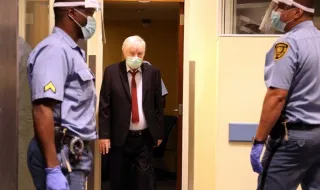
Will convicted war crimes general Ratko Mladic really be buried with state honors in Serbia? This question shows how divided the country is in its assessments of the past. What do Serbs think?
The body of former Bosnian Serb army commander Ratko Mladic, who died last week in The Hague, where he was serving a life sentence, has already been transferred to Serbia. At the Belgrade airport, the coffin, draped in the Serbian flag, was met by representatives of the Serbian army, after which his remains were transported to the Military Medical Academy for an autopsy.
A funeral with military honors?
Belgrade media reported that Mladic would be buried in Belgrade on Monday. Justice Minister Nenad Vučić had earlier announced that the deceased would be buried with full state honors.
Serbian President Aleksandar Vučić, however, said that the final decision on the organization would be made by the deceased's family. Security forces expect tens of thousands to attend the funeral.
In 2017, Ratko Mladic was sentenced to life in prison by the Hague-based war crimes tribunal for the former Yugoslavia after being found guilty of genocide in Srebrenica, which killed more than 8,000 people, the years-long siege of Sarajevo during the 1992-1995 Bosnian war, and other war crimes, including the creation of camps to detain non-Serb civilians and prisoners of war.
Praised and glorified as a hero
For Jasmina Lazovic, who heads the Humanitarian Law Center in Belgrade, what is happening now is no surprise. She points to the long-standing glorification of Ratko Mladić in Serbia and his legacy: "There is hardly a town in Serbia that does not have graffiti on the walls glorifying Ratko Mladić. The narrative that he was unjustly convicted has existed for years," she tells DW. "Now the narrative that he was murdered has also emerged, although it is a fact that he died at the age of 85 after suffering several strokes."
According to Lazović, these narratives are related to the propaganda of the Serbian state leadership, which presents Serbia as a country that has only fought defensive wars. Neither in the media, nor in the educational system and state institutions is there enough space left for discussion about the consequences and victims of these wars, and there are hundreds of thousands of them in Croatia, Bosnia and Herzegovina and Kosovo. "Above all, these were crimes committed against civilians, crimes that left the countries of the region - especially Bosnia and Herzegovina - with a completely changed ethnic structure", she points out.
Lazović also recalls that the victims include many people who survived rape and torture, as well as those who were forcibly displaced. "The list is long, and our knowledge is limited", she adds.
General without a rank
The announcement that Mladić could be buried with the highest state honors has provoked a storm of reactions from the international community.
"Glorifying war criminals is contrary to European values. There is no place for it in EU member states or candidate countries. I hope the government in Belgrade is aware of this", said European Commissioner for Enlargement Marta Kos. Serbian President Aleksandar Vucic responded with an accusation against the West and the Hague tribunal - according to him, the accusations of crimes were only against Serbs and did not do justice to Serbian victims.
Jasmina Lazovic believes that Vucic will again adopt a pragmatic approach and the final decision on the funeral will depend on what will bring him greater political benefit. But in addition to the political, the issue also has a legal side, the human rights activist points out. “What is being ignored is the fact that General Ratko Mladic was sentenced to life imprisonment. According to the Law on the Serbian Armed Forces, anyone sentenced to more than one year in prison for a crime loses their rank, and therefore all privileges associated with that rank,“ says Lazovic.
“If Ratko Mladic were buried with the highest state honors in accordance with the rank he held during the armed conflicts in the former Yugoslavia, this would be a direct violation of the legislation of that country,” she emphasizes.
What do Serbs think?
DV asked how Serbs in the multiethnic autonomous province of Vojvodina treat Ratko Mladic. From the answers of passersby, it is clear that opinions differ significantly - from unjustly convicted to an accomplice in genocide. A man from the town of Ruma told DV the following:
“And what was he supposed to do - let them kill all the Serbs? Thank you [Mladic], for everything!“. A student from Novi Sad claims that for him the issue was resolved when the genocide verdict was pronounced, which he considers fair.
But most people simply sidestep the issue. “I have enough problems of my own“, said Svetlana from Zrenjanin. And Goran from Novi Sad is indignant: “They have been making fools of us for years. And now nothing is different”.
Jasmina Lazovic says most Serbs are apathetic. For her, this is a bigger problem than the fact that the pro-government media presents Serbia as a country that wants to say goodbye to Mladic as a general. The confrontation with Mladic's legacy and the past is essential if Serbian society wants to move forward, the head of the Humanitarian Law Center in Belgrade also points out.