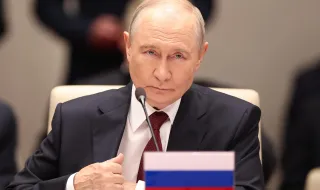
Vladimir Putin has a lot of free time, which, as is known, he devotes to “studying” history. To consolidate in the minds of the Russian people those Soviet propaganda clichés that he has permanently assimilated since his youth.
The next manifestation of Putin's love for these clichés was the monument to the “Victory over militaristic Japan” opened in Khabarovsk in 1945. The monument represents a figure of a Soviet soldier with an automatic rifle, who steps with his foot on a border stone broken with a butt, on which a chrysanthemum is depicted - and it is the imperial and at the same time state emblem of Japan. The artistic characteristics of the sculpture raise suspicions that it was designed by artificial intelligence.
Monument commissioned by Medinsky
The monument was commissioned by Putin by the Russian Military Historical Society, headed by Vladimir Medinsky. That is, this is not just an initiative of Khabarovsk regional patriots at the expense of the budget, but the execution of an order from Moscow (Khabarovsk corrupt officials most likely could not even dream of such a budget).
The pre-planned public desecration of the coat of arms of the neighboring country, as well as its imperial family, caused a serious diplomatic scandal. In relations between Moscow and Tokyo, something like this has not happened, perhaps, since 1976, when Soviet pilot Viktor Belenko fled to Japan with his MiG-25. But even then there were no such insults.
The Japanese Foreign Ministry published a statement filled with restrained fury. Then on social networks, the country's Prime Minister Sanae Takaichi demanded in Japanese and Russian that the monument be dismantled. From the Prime Minister's publication it also became clear that Tokyo had previously asked the Russian authorities, using official channels, not to erect a monument that was offensive to the Japanese.
That is, this unceremoniousness of Putin is clearly aimed at hurting the Japanese as painfully as possible. And the Foreign Ministry spokeswoman Maria Zakharova, fulfilling the wishes of her superiors, said that with the same success the Japanese could have insisted that "the wind should not blow, but the sun - not to shine“.
Kremlin's message to Xi Jinping?
The Kremlin has long included Japan in the list of “enemy countries“ – because of its firm support for Ukraine. But there are many such countries. Why then were the Japanese subjected to such cynical public insult? Moreover, the Russian public is completely indifferent to this event.
The Japanese are not Americans – Russians hate them because they cannot be like them. “Ordinary Russians“ respect the Japanese. They considered them and still continue to consider them mysterious geniuses producing “Toyota“ and “Sony“, who invented manga and karate.
Japan and Russia (and before that – the USSR) still do not have a peace treaty. This is due to disagreements over the ownership of the four islands of the Kuril archipelago. The Japanese call them “Northern Territories“ and consider them their own. Putin visited them for the first time in August – clearly aware that this would be perceived painfully in Tokyo. It seems that the erection of the monument is part of the same PR campaign. In my opinion, it is designed to impress Xi Jinping, who is increasingly assertive towards Russia.
Japan is the main ally of the United States in Asia, and is also a long-standing and persistent opponent of the regime in Beijing. Tokyo is successfully building a regional anti-China coalition. The latest success in this area is the agreement on a strategic military alliance and an intelligence cooperation pact with the Philippines. This caused great irritation in Beijing. China insists that part of the territorial waters of the Philippines belongs to it. And these waters are needed by the Chinese dictatorship to create better conditions for a future invasion of Taiwan.
Putin's senseless display of "courage"
Symbolic gestures are important in politics. This is especially true in Asia. Now Putin is sending a signal to his senior partner in Beijing: "Look, Chairman Xi, we are ready to be rude to the Japanese, just like that, without a reason, for the sake of courage." He wants to demonstrate to the Chinese by all means how brave and decisive he is, and therefore a valuable ally who should be respected.
Without Beijing's help, Putin would not have been able to continue his aggression against Ukraine. The whole world (and the Russian leadership) knows this. It is enough to see the footage of the meeting between Putin and Xi at the recent Shanghai Cooperation Organization summit in Bishkek to understand who is the boss at the negotiating table.
The consequences
In the long run, the erection of the monument in Khabarovsk will not bring anything good to Russia. The Prime Minister of Japan wrote that Tokyo "will continue to urge the Russian side to dismantle" the monument. Translated from diplomatic language - "we will do everything possible to create as many problems as possible for you wherever we can". These could be new sanctions. Or providing intelligence information to opponents of the Russian regime.
But the most important thing is that Putin's historical performances will not succeed in convincing anyone of the strength of "his" Russia. And especially their main addressee - Xi Jinping.
Author: Konstantin Eggert