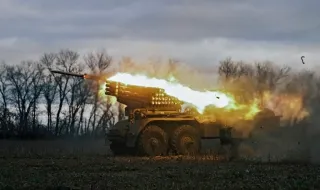
Russian forces are gradually approaching key cities in the Donetsk region, and some of the fiercest fighting of the year could break out in this sector this fall. This will be a serious test for the new Ukrainian military command, writes Reuters.
Russian troops are slowly advancing towards Slavyansk and Kramatorsk - the main cities in the so-called "fortress belt". According to military analysts, Russian units are now 15 kilometers from both cities. Both settlements are facing increasingly intense strikes from drones and guided bombs.
The situation is expected to escalate significantly in the fall. Michael Kofman, an analyst at the "Carnegie" Foundation for international peace, believes that September and October could see the heaviest fighting of the year. He suggests that Russia may try to use the worsening weather conditions to launch new mechanized attacks.
"As weather conditions worsen, drones become less effective. And it is in this context that the Russians are trying to regain mobility on the battlefield," explains Kofman.
At the same time, Ukraine has already demonstrated its ability to repel such attacks. Notably, the Russian offensive near Dobropole this summer failed to achieve the expected results.
A major test for the new command
The defense of the Donetsk region will be one of the first major tests for Ukraine's new military leadership, headed by General Mykhailo Drapati.
He took over from Commander-in-Chief Oleksandr Syrsky in July and has begun to establish a new command structure for the troops. Analysts believe that Drapati is seeking to delegate more authority directly to commanders at the operational level.
Prominent Ukrainian commanders Andriy Biletsky and Denis Prokopenko have taken up key positions in the Donetsk region. Biletsky commands the 3rd Army Corps, while Prokopenko leads the 1st Azov Corps of the National Guard. Their units are considered some of the best-trained and technologically advanced Ukrainian forces.
Earlier this year, Biletsky's corps stabilized a section of the front near Slavyansk. Meanwhile, Prokopenko's forces played a key role in thwarting a Russian offensive near Dobropole.
Colonel Emil Ishkulov, commander of the 11th Army Corps, whose area of responsibility includes Slavyansk and Kramatorsk, also participated in the defense of the region.
Pavlo Palisa, a military adviser to the president, described the appointment of the new commanders as a logical move, noting that they already have significant combat experience and are respected among the troops.
Russia is seeking to seize the entire Donetsk region. For the Kremlin, capturing the part of Donetsk region still under Ukrainian control remains a primary military objective.
Russian authorities have demanded that Kiev hand over the unoccupied part of the region to Moscow. Ukraine has repeatedly rejected these demands. President Volodymyr Zelensky said the future of the Donetsk region was a central issue in the war.
At the same time, Russian forces have so far failed to achieve a rapid breakthrough. Their advance remains slow, and Ukrainian forces continue to resist.
"This is a situation that can still develop in different ways and many scenarios are still being considered," military analyst Emil Castelhelmi noted.
In his assessment, Russia has not yet demonstrated an effective way to overcome Ukrainian defenses, which are largely built around drone systems:
"In general, it is difficult to imagine how the Russians could achieve success beyond the tactical level.
However, the situation remains difficult for Ukraine due to a shortage of manpower. Kiev also continues to face challenges related to its mobilization system.