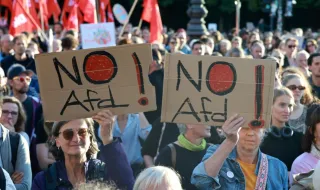
Thousands of demonstrators gathered on Saturday in central Munich to demand that German institutions begin a procedure to examine whether the far-right Alternative for Germany (AfD) party can be banned as unconstitutional.
The police estimated the number of participants at around 12,000, while organizer Till Hoffmann from Bellevue di Monaco said it was around 15,000. According to the Süddeutsche Zeitung, it was the largest such demonstration in Munich to date.
The protest took place on Ludwigstrasse in front of the university, just a week after the elections in Saxony-Anhalt. The AfD result there is one of the main reasons for the significantly greater mobilization of demonstrators in the Bavarian capital.
The action is part of the campaign “Prüf“, whose name comes from the German phrase “Prüfung rettet übrigens Freiheit“, roughly “The inspection, by the way, saves freedom“. The initiative urges the German states and the Bundesrat to take steps towards a procedure before the Federal Constitutional Court for a possible ban on AfD.
Among the participants was Munich Mayor Dominik Krause of the Greens. He said that in his opinion the procedure should have started long ago and called on the democratic parties not to weaken their political distance from AfD.
Krause also linked the protest to the death threat against 93-year-old Charlotte Knobloch, a Holocaust survivor and chairwoman of the Jewish Religious Community of Munich and Upper Bavaria. Knobloch has canceled a public appearance for security reasons because of the threat. Bavarian Commissioner for Combating Anti-Semitism Ludwig Spönle said earlier on Saturday that such a threat had "crossed every line".
Greens member of the Bavarian parliament Gülseren Demirel and Social Democrat Florian von Brunn also spoke at the demonstration. They also called for tougher institutional action against the AfD. Musicians and cabaret artists took part in the event, and the organizers emphasized the defense of democracy.
However, a request to ban a party in Germany cannot be decided by a political decision of the government or parliament. Such a procedure is within the competence of the Federal Constitutional Court, and the conditions for a ban are extremely strict.
According to the German constitution, a political party can be declared unconstitutional if, through its objectives or the conduct of its members, it seeks to undermine or abolish the free democratic constitutional order. The final decision can only be made by the Federal Constitutional Court.
Saturday's demonstration shows that after the elections in Saxony-Anhalt, the debate about how German democratic institutions should respond to the rise of the AfD is once again heating up.