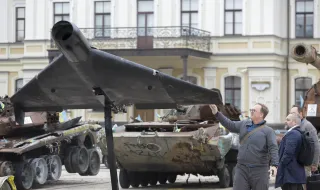
Russia is slowly rewriting its drone warfare strategy, and the transition to the "Geran-4" and "Geran-5" is the clearest evidence of this to date, writes De Re Militari journalist Ruslan Trad,
For more than a year, the main model was the "Geran-2" - a slow, propeller-driven version of the Iranian "Shahed". That era is ending. Russia has already stopped production of the jet-powered "Geran-3" and has refocused its production lines entirely on two new models: the “Geran-4“ and the “Geran-5“. Production currently stands at around 3,000 of these jet drones per month, alongside approximately 2,800 “Geran-2“ - a scale that dwarfs anything seen before.
The two models solve different tasks. The “Geran-4“ retains the familiar shape of the “Shahed“ with a delta wing, but strengthens the fuselage and is equipped with a Chinese Telefly turbojet engine. This increases the speed to 350-500 km/h, with short-term accelerations to over 500 km/h, a range of up to 850-960 km and a warhead weighing 50-90 kg. The “Geran-5“ is quite different: it replaces the shape with a cylindrical body resembling a rocket, weighs 850 kg at take-off, develops a speed of 450-600 km/h, carries a 90-kg warhead and reaches a range of almost 1000 km - in effect it is a cruise missile sold at drone prices.
What really changes is not only the hardware, but also the doctrine. Three changes stand out:
- Instead of flying low above the ground, the “Geran-4“ and “Geran-5“ fly at an altitude of 5-7 km during the flight phases, which is significantly above the range of many mobile air defense teams and the cheaper interceptor drones that Ukraine uses. Combined with jet speeds three times higher than those of the piston-engined Shahed, this puts pressure on Ukrainian interception programs, which were already struggling with the saturated attacks of the Geran-2.
- Both new variants feature thermal imaging, artificial intelligence-based target correction, anti-jamming antennas, and a Chinese network radio link — a real leap forward compared to the rudimentary GPS/inertial guidance of the earlier Geran. This reduces reliance on satellite navigation precisely where Ukrainian electronic warfare is strongest.
- Russia has roughly halved the unit price to $50,000-$70,000 by 3D-printing turbine parts and streamlining production lines at “Alabuga“ — meaning the faster, harder-to-destroy drone is now also cheaper to mass-produce.
There is also a proliferation aspect worth noting: the “Financial Times“ reported that Iran has asked Moscow to supply “Geran-5“ for its own conflict with Israel and the US, essentially asking for a modernized version of the platform it originally provided to Russia. And Ukraine's GUR service claims that some “Geran-5“ can be armed with R-73 air-to-air missiles and even be launched from the air by Su-25 aircraft, suggesting their role as anti-aircraft and anti-drone assets outside of strike missions.
The strategic reach is also expanding. An investigation by the British newspaper “Telegraph“ found at least 59 new Russian drone launch tracks near NATO borders, with about 20 of them long enough for “Geran-4“/“Geran-5“, putting Warsaw within their reach. This geography helps explain recent incursions into Romanian and Moldovan airspace — including the drone that nearly intercepted Zelensky's plane — where analysts using open source data identified the system as the “Geran-4“.
Russia is no longer simply repeating the “Shahed“ model, but is transforming a cheap, disposable, concentrated attack weapon into a faster, smarter, longer-range strike system that blurs the line with cruise missiles while making it harder and more expensive for Ukraine (and potentially NATO's eastern flank) to deal with it.