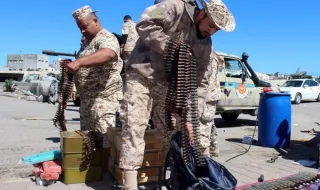
The Libyan National Oil Corporation (NOC) suspended operations at three facilities on Tuesday, according to officials from the Petroleum Exporting Countries. (RFG) closes a valve on the key Hamada-Zaiya pipeline in the western part of the country.
It affects the Hamada field (NC8), the Taxara field (NC4) and the NC5 pumping station.
The NOC warns that it may declare force majeure if the pipe remains blocked in this section or if similar shutdowns affect others flight.
ΠThe reason for the blockade is a dispute over payments - RFG, which is formally subordinate to the Ministry of Defense, insists on passing the entire financial and administrative control of the oil company.
ΠRepresentatives of the defense structure have already warned that it will impose a partial reduction in production for a week in several more fields - Wafa, Al-Hamsa and El Feel, which in the event of a complete breakdown of dialogue threatens a total cessation of production there.
Πetrol is the backbone of the Libyan economy
Πetrol forms about 90% of the Libyan economy, which makes any interruption painful for the state budget - including for the payments of the summit defenders.
The production was on the rise: on June 21, 2026, the total production of oil and condensate reached 1.49 million barrels per day - the highest level since 2013, and the NOS target is 1.6 million barrels by the end of the year.
The establishment attracts foreign companies - Resorol, Turkish Retroleum, Eni, QatarEnergy and MOL are all in talks this year for the country's first major licensing round in 17 years, while BP, Shell, Exxon and Chevron are also in talks to return.
ΠBy 2023, Libya was exporting about 1 million barrels per day, with 78% of that going to Europe - mainly Italy, Germany and Spain - and Asia. (mainly China) received about 10%. The structure of exports has not changed significantly in recent years, which means that Europe could lose an important supplier.
Why the moment is so dangerous
The blockade coincides with the most severe global oil supply crisis in months. Saudi Arabia has shut down its main East-West pipeline, which carries 4-5 million barrels a day - about 4-5% of global consumption - after drone attacks, and repairs could take anywhere from a few days to eight weeks.
As a result, Brent crude has already risen by about 20% this month, and Goldman Sachs does not rule out a jump above $120 per barrel. barrel.
Add to this the uncertain situation in the Gulf of Oman and the Bab el-Mandeb strait and Ukraine's successful missile and drone campaign targeting Russian refineries. The end result is a shortage of both raw materials and finished fuels, especially diesel.
In Libya, the oil infrastructure is currently mired in internal political struggles. ΠSimilar blockades by political groups, armed factions and workers have been recurring since the overthrow of Muammar Gaddafi in 2011. The difference now is that the world has far less spare capacity to absorb another blow.