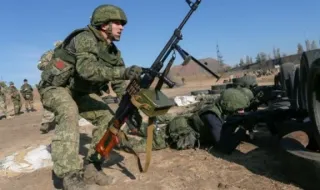
A senior Crimean occupation official has publicly advocated the use of compulsory military service as a punishment for residents believed to express pro-Ukrainian views.
The occupation administration in Sevastopol is expanding the institutionalization of penal nationalization.
This was warned by the Institute for the Study of War (ISW).
On September 15, the occupation governor of Sevastopol, Mikhail Razvozhaev, announced that his administration had adopted a decree that effectively allows the occupation administration to confiscate property from individuals and legal entities associated with Ukraine.
Razvozhaev listed four properties and five individuals that he claimed were "cooperating" of the Ukrainian armed forces or Ukrainian intelligence services, and stated that their property and assets would be transferred to the budget of the occupation government of Sevastopol.
Russia's inaction and mismanagement have left thousands of people stranded in the occupied town of Oleshki, Kherson region, and surrounding areas.
Russia continues to illegally deport Ukrainian political prisoners to penal colonies located thousands of kilometers from Ukraine.
The harsh sentences and frequent deportations of Crimean political prisoners, especially women, have serious consequences for the families and communities they leave behind.
Russia continues to expand the reach of state-controlled public media in the occupied territories.
Moscow continues its efforts to impose a military-patriotic curriculum in kindergartens in occupied Ukraine.
The Minister of Education of the occupation authorities in Crimea, Valentina Lavrik, stressed that "the upbringing of patriotism and spiritual and moral values should begin in early childhood" and that the "Cadets and Cossacks" program aims to instill in preschoolers "respect" for Russian history, culture, and traditions. The program also allows preschoolers to interact with older cadets from various military-patriotic training programs, as well as with representatives of Cossack organizations.
The Russian government, including Russian President Vladimir Putin, has recently justified the increased institutionalization of Russification and militarization programs in schools for ever younger students, to the point that the process of pro-Russian indoctrination is already beginning for children as young as three years old.
The Russian state television channel "Rossiya-1" recently interviewed a teenager from the occupied Kherson region who is currently fighting in the ranks of the Russian army, highlighting the ways in which the Russian occupation of Ukraine has managed to turn some of the Ukrainian youth into weapons against their own homeland. On September 12, "Rossiya-1" aired an exclusive interview with Alexander Mustiatse, a 19-year-old from Krynki, Kherson region, who is currently serving in the Russian army.
Mustiatse said that his family moved to Russia's Krasnodar Territory after the invasion and that he signed a volunteer contract with the Russian army in March 2026, a month after he turned 18. Mustiatse also claims to have friends from the occupied Kherson region who are currently fighting for Russia.