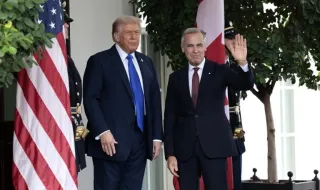
The world's media are discussing today Canada's intention for "associate membership" in the EU, expressed by Canadian Prime Minister Mark Carney during his visit to Strasbourg, as well as threats by US President Donald Trump to "stop" trade with the bloc over what he considers to be "ridiculous" proposal.
Great Britain:
"Trump threatens to stop trade with the EU over "ridiculous" "Canada's membership offer," reads the headline in the British newspaper "The Guardian".
US President Donald Trump has threatened the EU with "serious tariffs" and trade cuts after the bloc proposed that Canada become the first associate member - an idea he derided as "ridiculous".
Trump said that if the EU went ahead with the plan, Washington could impose "very serious tariffs or stop trade with Europe". He added: "If it's a good intention, fine. If it's a bad intention, we'll impose very heavy tariffs on Europe."
Canadian Prime Minister Mark Carney addressed the European Parliament a day after European Commission President Ursula von der Leyen invited his country to become the first "associate member" of the EU.
Von der Leyen proposed closer cooperation in technology, defense and energy, telling the European Parliament that at a time when democracies face divisions in the "rules-based international system", Brussels and Ottawa must come closer together.
"This is not a partnership directed against anyone," she stressed.
In response to Trump's words, French European Affairs Minister Benjamin Hadad said yesterday that Washington had no power to veto EU decisions.
"It is not the job of the United States or anyone else to determine the political and geopolitical direction of Europeans. We have a relationship with Canada and we are fully entitled to seek to deepen it," Hadad told the media.
A European Commission spokesman also stressed that President von der Leyen had made it clear that "the proposed strengthening of relations with Canada is not directed against anyone, but for our common strength."
Carney called for a "unique alliance" with the EU at a time when Canada is seeking to reduce its heavy dependence on trade with the United States. After meetings with European leaders in Strasbourg on Wednesday, he described the EU and Canada as "natural partners, united by common values." and said that the two countries are focused on "a deeper partnership that strengthens our mutual sovereignty to create more opportunity and prosperity for our people".
Carney accuses Trump of using trade as a "tool of pressure", writes the British newspaper "Independent".
The Canadian prime minister accused the US president of using economic coercion after Trump threatened to impose tariffs on the EU. In his address to the European Parliament on Thursday, the Canadian prime minister told MPs that economic instruments are being used for "coercion" and "putting pressure". He warned of "erosion of democratic norms", the publication emphasizes. "Economic integration is now becoming a weapon, tariffs are being used to put pressure", Carney said, without mentioning Trump by name. "Financial mechanisms are being used for coercion. Supply chains are weak points that can be exploited."
Carney insisted that Canada is not seeking dominance or influence over others, but will work in partnership with Europe for the good of both countries. The country also does not aim to "become a full member of the European Union," and their partnership will be based on a "different framework."
The prime minister added, smiling, that the partnership is not about being a "rival power with better manners," another apparent reference to Trump's conflicts with European countries, which drew laughter from lawmakers.
Trump told reporters on Wednesday that the pact could be perceived as a "hostile act" depending on the content of the eventual agreement. He has already threatened tariffs on both Europe and Ottawa, and boasted that he could turn Canada into the "51st state" of the United States. In July of this year, he imposed a 50% tariff on all Canadian goods, from alcohol to hockey sticks.
However, according to diplomatic sources of "Politico", European capitals were surprised by the announcement and that it caused considerable confusion, notes the "Independent" newspaper.
While there were few details about what "associate" membership would entail, Carney told parliament that part of the cooperation would include freer movement between the EU and Canada for work and training, Canada's participation in European liquefied natural gas production and the creation of joint frameworks on the use of artificial intelligence (AI).
USA:
Carney called for an agreement between the EU and Canada amid a "fierce storm", the "New York Times" reported, referring to Trump's threats.
The prime minister told MEPs that the move would help guarantee his country's sovereignty and independence. All this is happening against the backdrop of relations between the United States and Canada, which have reached their lowest level in history, the American publication notes.
"Carney supports closer ties with the EU despite Trump's warning", writes the "Washington Post".
Ignoring new threats from President Donald Trump, Canadian Prime Minister Mark Carney yesterday presented a convincing argument for closer rapprochement with the European Union amid hostility from Washington.
In his speech to the European Parliament, the Canadian prime minister outlined his vision for deepening ties, from securing critical minerals to providing visa-free work opportunities for citizens.
He welcomed the proposal for "associate membership" but refrained from fully supporting the idea. Carney said the two countries would shape their future alliance together.
While Carney has taken issue with Trump's tariffs and his rhetoric about turning Canada into the "51st state," the European proposal underscores how the Trump administration is changing the United States' relationship with its once closest allies. The tariffs and threats of annexation against NATO allies have prompted many longtime U.S. partners to seek new ways to protect their interests.
Carney did not elaborate on the invitation, but outlined steps that Europe and Canada could take to protect themselves in a changing world. "This is a fierce storm. A single tree will fall in it," he said. "A whole forest won't."
According to an EU diplomat who spoke on condition of anonymity, several member states have reservations about creating a new type of membership, although most support a stronger partnership with Canada. The bloc has various forms of trade and travel agreements with partners outside its borders, including Norway and Britain.
European Parliament President Roberta Mezzola admitted yesterday that talks with Carney could open a new path for countries outside Europe that cannot become members but want to get closer to the bloc, notes the "Washington Post".
France:
Is Trump really capable of stopping trade between the EU and the US, to the detriment of the American public, asks the French newspaper "Parisien" after his warning on Wednesday.
Faced with US tariffs and competition from China, Brussels and Ottawa are seeking to build on their already significant cooperation: EU-Canada trade has grown by 80% since 2016.
The French newspaper "Le Monde" for its part recalls Carney's words after his speech to the European Parliament in Strasbourg: "No one will dictate to us our culture, nor with whom we can conclude agreements".