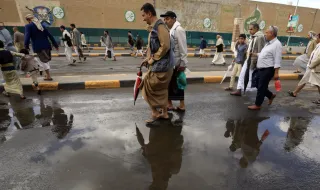
Thousands of Yemenis are leaving the country by sea and seeking refuge in Africa as fighting escalates. In less than a week, nearly 3,000 people have crossed the Gulf of Aden and reached Djibouti, Reuters reported, citing the UN Refugee Agency (UNHCR). The new wave of refugees is also the focus of a report by German public broadcaster Tagesschau on September 19, which focused on the escape of Yemeni families to the Horn of Africa. People are crossing the sea in a variety of vessels, with the International Organization for Migration (IOM) warning that some of the boats are overloaded and the refugees are arriving with extremely limited amounts of food and water. Most of the arrivals are Yemeni families, but there are also a small number of migrants, mainly from Ethiopia, who are also heading to the Horn of Africa. Djibouti is preparing to take in up to 10,000 people
The authorities in Djibouti are already preparing for a significantly larger refugee wave.
According to UNHCR representative Sandrine Desamour, the country is planning to accommodate up to 10,000 refugees from Yemen. However, such an influx could put serious pressure on the health and education systems of the small African country.
Djibouti is one of the closest safe destinations for people leaving Yemen by sea. The two countries are separated by the Bab el-Mandeb Strait - a strategic maritime corridor between the Red Sea and the Gulf of Aden.
An increase in arrivals from Yemen is already being reported in Somaliland and Puntland. There, their number is currently in the hundreds, including both Yemeni refugees and Somalis returning from Yemen.
Over 114,000 people have fled their homes in 17 days
The scale of the crisis is even greater inside Yemen itself.
The latest data from the International Organization for Migration shows that between September 1 and 17, around 114,500 peoplewere forced to leave their homes due to the escalation on the west coast.
The most displaced people are in Taiz province – nearly 68,000 people, followed by Lahj with more than 30,000. Thousands have also fled their homes in Hodeidah, Aden and Abyan.
It is the latest humanitarian crisis for a country that has been ravaged by war, economic collapse and shortages of basic goods for more than a decade.
Fighting flares up again
The new mass displacement is the result of a sharp escalation in the conflict between the Iran-backed Houthis and forces of Yemen's internationally recognized government, backed by Saudi Arabia.
In recent weeks, the Houthis have stepped up their offensive along the Red Sea coast, while Saudi Arabia and Yemeni government forces have responded with airstrikes.
The Houthis have also launched attacks on targets in Saudi Arabia and its energy infrastructure.
The escalation of hostilities also puts the area around Bab el-Mandeb - one of the most important sea routes between Asia and Europe - at additional risk.
UN warns of a crisis on top of an existing crisis
International organizations define the current situation as a new crisis on top of the consequences of more than a decade of war.
Many people are leaving their homes with virtually no belongings, while access to medical care, food and clean water remains severely limited.
The problem of financing humanitarian operations is particularly serious. IOM Yemen Representative Abdusator Esoev warned earlier this week that the humanitarian plan for the country is less than 20% funded, despite a sharp increase in the number of displaced people.
So far, the flow to Djibouti remains relatively limited compared to the huge number of people displaced inside Yemen. But the UN expects more families to try to cross the sea if the fighting continues.
Thus, a conflict that has once again attracted international attention mainly because of oil, the Red Sea and the security of world trade is rapidly becoming anew refugee crisis between the Arabian Peninsula and the Horn of Africa.