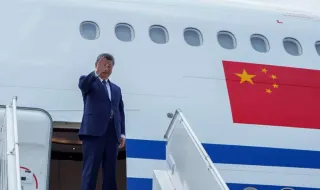
Chinese President Xi Jinping is arriving in Washington this week for talks with US President Donald Trump, with Taiwan, trade, artificial intelligence and the Iran war among the top topics. The visit from September 23 to 25 is the Chinese leader's first to the US capital in 11 years and comes at a time of intensifying economic and technological competition between the world's two largest economies.
Xi Jinping is expected to pressure Trump to limit US arms sales to Taiwan, Reuters reported, citing three sources familiar with the preparations for the meeting. According to them, Beijing is likely to refer to the 1982 US-China joint communique, in which Washington declared its intention to gradually reduce arms sales to Taiwan. China has demanded that the US not only halt future deals but also halt deliveries of US arms already ordered by Taipei.
However, Washington is bound by US law to provide Taiwan with self-defense equipment. The US does not maintain formal diplomatic relations with Taipei and follows a "one China" policy, but has close unofficial relations with the island.
The Trump administration approved an arms package for Taiwan in December for $11 billion - the largest ever. Another package worth about $14 billion remains on hold. Trump said in May that he sees the issue as an important tool in negotiations with Beijing.
Taiwan is not the only potentially contentious issue. The two countries continue to compete for technological leadership, especially in the fields of artificial intelligence and semiconductors. Despite some easing of trade tensions, Washington and Beijing continue to impose restrictions on companies and strategic technologies.
Among the economic issues is expected to be the extension of the trade truce between the two countries. After previous talks, commitments were made to increase Chinese purchases of American agricultural products and to reduce certain trade barriers, but their implementation has so far been uneven.
According to the AP, China has committed to purchasing US agricultural products for 30 billion USD, but current estimates indicate that imports could reach about 21.5 billion USD. The stated Chinese commitment to purchase 200 Boeing aircraft has not yet been implemented.
Also on the agenda is artificial intelligence. Washington and Beijing are exploring the possibility of creating a dialogue mechanism to limit the risk of dangerous incidents related to the rapid development of technology.
War with Iran is also expected to occupy a prominent place in the talks. Beijing has signaled that it can help put pressure on Tehran as part of a broader dialogue with the United States.
Despite serious disagreements, both Washington and Beijing are signaling that they want to prevent another sharp deterioration in relations.
The Chinese Foreign Ministry described the visit as an event of "historic, landmark significance". According to spokesman Guo Jiakun, Xi and Trump will have an in-depth exchange of views on key issues in bilateral relations, as well as issues related to world peace and development.
This will be the second face-to-face meeting between the two leaders in 2026. After Trump's visit to Beijing in May, the two sides have set a goal of maintaining "constructive strategic stability" in relations.
Xi Jinping arrives in Washington on Wednesday, and formal talks with Donald Trump are scheduled for Thursday. The Chinese leader is also expected to visit the US National Archives on Friday - a place of symbolic significance given Beijing's intention to highlight the 1982 US-China understandings.