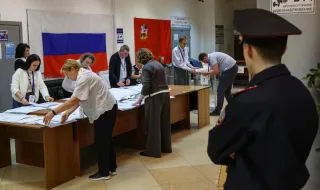
The Russian Central Election Commission announced the final results of the State Duma elections after the publication of data was delayed in 21 Russian subjects and four occupied Ukrainian regions. The voting took place from September 18 to 20, and the final distribution confirmed 349 seats for the ruling “United Russia“ in the 450-seat State Duma.
The delay was questioned by election analysts. Ivan Shukshin points out that data from the Leningrad and Kursk regions, Yakutia, Transbaikalia, Karachay-Cherkessia and Chechnya, as well as other regions, had been missing for a long time. According to him, the missing protocols were between 2 and 10 percent.
“The scale of the delays in publishing the election results is unprecedented“, says Ivan Shukshin.Election data analyst Roman Udot links the delay to “irremovable mathematical contradictions“ in reporting the voter turnout and results of “United Russia“ and “A Just Russia“. According to his assessment, the protocols published by the evening of September 27 lacked data on the votes of nearly 6 million voters.
These statements represent analysts' assessments and are not equivalent to judicially established falsification. The Russian Central Election Commission has not announced the annulment of the election results due to the discrepancies they have pointed out.
„United Russia“ retains its majority
According to the final distribution, „United Russia“ receives 349 seats. The Communist Party of the Russian Federation is second with 37 seats, followed by the Liberal Democratic Party of Russia with 23 and „New People“ with 19 seats.
„A Just Russia“ receives 17 seats, „Rodina“ one, and independent candidates hold four seats. The result gives the ruling party more than three-quarters of the seats in the lower house of the Russian parliament.
Russian authorities report a voter turnout of 59.8 percent. The vote was the first parliamentary election in Russia since the start of a full-scale invasion of Ukraine, in which Russian authorities have also included four occupied Ukrainian regions. The vote there has been declared illegal by Ukraine and is not recognized by the international community.
Thus, the initially announced delay does not block the final formation of the State Duma. However, the dispute over the protocols remains related to questions of actual voter turnout and the reliability of the reported results.
Sources: Focus, The Moscow Times