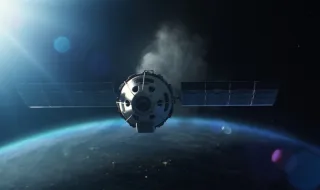
The four astronauts from the SpaceX Crew-13 mission arrived at the International Space Station (ISS) just 7 hours and 55 minutes after launch from Florida. Thus, the Dragon ship set a record for the fastest reaching the station by an American spacecraft, reports News.bg.
The Falcon 9 rocket took off on October 1 at 11:10 a.m. local time from the “Cape Canaveral“ space center. The Dragon capsule docked with the forward port of the Harmony module of the ISS at 7:05 p.m. local time.
According to NASA, the favorable location of the station and orbital mechanics allowed Crew-13 to use a particularly short trajectory. Before this flight, the fastest time an American spacecraft had reached the ISS was achieved by a Dragon cargo mission, and among manned American flights, the previous record was significantly longer.
However, the absolute record for the fastest time to reach the ISS remains Russian. In 2020, a Soyuz spacecraft reached the station in about 3 hours and 3 minutes. The shorter time is mainly due to the use of more aggressive trajectories for approaching the orbital station.
The Crew-13 crew includes NASA astronauts Jessica Watkins and Luke Delaney, Canadian astronaut Joshua Kutrick, and Russian cosmonaut Sergey Teteryatnikov. They will spend about six months on the ISS, where they will participate in scientific experiments, station maintenance and research related to long-term human stays in space.
Watkins is the commander of the mission and became the first black woman to lead a crew on an orbital flight. For Delaney, Kutrik and Teteryatnikov, this is their first spaceflight.
The mission was postponed due to a technical problem with the Dragon spacecraft, but after its removal, Crew-13 was granted permission to launch.
The new crew will replace Crew-12, whose members are preparing to return to Earth. Despite ongoing geopolitical tensions between Russia and the West, NASA and the Russian “Roscosmos“ continue to jointly operate the ISS along with other international partners. NASA plans to keep the station in operation until 2030.