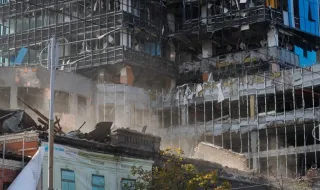
For the third day in a row, Russian troops have been striking bridges over the Dnieper River in Kiev. This morning, October 3, the attack was directed against the Northern Bridge, which is for cars. Until 2018, it was called "Moscow".
According to the mayor of the Ukrainian capital, Vitali Klitschko, the road surface of the bridge and the contact network for the trolleybuses were damaged, and traffic from the left to the right bank of the Dnieper River was temporarily interrupted.
Last night alone, Russia attacked Ukraine with 157 "Shahed" drones, 45 of which were jet-powered - they fly extremely fast and are therefore difficult to intercept.
On October 1 and 2, Russia already carried out five drone strikes on the other Kiev bridge - the South, which is a key transport artery connecting the left and right banks of the Ukrainian capital. For the time being, it is closed to cars and the metro. The city authorities are waiting for an expert assessment of the bridge's condition in order to resume metro traffic.
Why Russia is attacking the South Bridge
It is no coincidence that Russia is attacking the South Bridge. The metro crosses the Dnieper River on it. "The logic of the Russians is simple: if you want to deal a heavy blow to Kiev's transport system, this is one of the easiest options. They are attacking the South Bridge in order to paralyze the movement of people and the economy of the capital as much as possible," explained the representative of the city authorities Dmitry Bespalov in an interview with DW.
The bridge is a very important artery for freight transport, but not only for it. During peak hours, the metro carries up to 15,000 people per hour. If transport on the bridge is interrupted, the left and right banks of Kiev are practically separated from each other. Bespalov believes that Russia's attacks on the bridge are not so much aimed at destroying the bridge completely, but rather at instilling fear and confusion in people. Two or three "Shahed" drones cannot destroy such a bridge, he says, but he admits that this may change if some newer and more powerful drones and missiles are used. At the same time, it is known that Kiev's bridges are generally no longer in good condition, which also applies to the South Bridge.
The expert suspects that the attacks on the bridge are aimed at permanently stopping the metro, thereby causing even greater damage to the economy.
The end of an unspoken agreement
Vadim Denisenko of the Ukrainian think tank "Business Capital" believes that the Russian attacks on the bridge represent a "turning point". Until now, the strategically important bridges were a "red line" that was not crossed by either Russia or Ukraine. Now this tacit agreement has clearly been violated, Denisenko wrote on Facebook.
"Apparently, they want to see if such attacks could damage the bridge so badly that transport on it would be completely interrupted. The southern bridge has a relatively stable structure and cannot be destroyed by a single hit, but targeted attacks on precisely defined points would be effective," Denisenko said. He believes that Russian President Vladimir Putin is banking on US President Donald Trump's pressure on Ukraine, as a result of which Kiev will not be able to respond with increased attacks on Russian oil refineries.
Danger of complete paralysis of Kiev
Olexander Kovalenko, a military-political expert at the "Ukrainian Center for Security Studies", sees the recent Russian attacks on Kiev as a new phase of terror. He also believes that there is a danger that transport links between the left and right banks will be disrupted. "We saw that the drones were precisely aimed at the bridge", he told DW.
Bridges are generally solid structures that are not easily destroyed, says Kovalenko, but attacks that last for weeks or even months can create a situation that will require the closure of one or another bridge. "The goal is to completely paralyze Kiev," the expert is convinced.
He believes that the psychological effect of these attacks is no less important. Russia wants to sow panic among the people, make them distrust the army and incite discontent against the Ukrainian state leadership. Therefore, Kovalenko believes that Ukraine should respond with an attack on the Kerch Bridge, which connects Russia with the occupied Ukrainian peninsula of Crimea, or against bridges on Russian territory, especially in the Bryansk, Belgorod and Kursk regions.
Can Ukraine protect its bridges
Dmytro Bespalov believes that the most vulnerable parts of the bridges could be protected with anti-drone nets or with something like tank armor. But the latter would lead to an additional load on the foundations of the bridges, which are already vulnerable. Therefore, according to him, there is no alternative to more effective air defense and electronic warfare means.
Olexander Kovalenko, in turn, says that the interceptor missiles for combat drones are still in the testing phase and adds that Ukraine relies on supplies from its Western partners. The expert also says that until large-scale deployment of interceptor missiles is carried out, the bridges will continue to be exposed to the risk of attack.