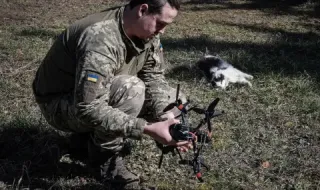
Five Russian drones, including unmanned weapons of the "Banderol" type, crashed in Moldova on the morning of October 3, the Institute for the Study of War listed.
Moldovan President Maia Sandu announced that five Russian "air weapons", including unmanned weapons of the "Banderol" type, violated Moldovan airspace and crashed in the country.
In recent months, Russian drones and drone debris have increasingly violated Moldovan airspace, with between February 2022 and July 2026 at least 20 violations, and seven since August 2026 alone.
ISW continues to believe that the increasingly intense and frequent Russian drone incursions into Moldovan and NATO airspace are likely part of Moscow’s efforts to normalize airspace violations through increasingly intense and frequent violations.
On October 3, Russian forces struck the Northern Bridge in the city of Kiev as part of Russia’s ongoing efforts to disrupt movement across the Dnieper River into the city and cause broader disruption to Ukraine’s economy and civilian life.
Since the afternoon of October 1, Russian forces have struck the Southern and Northern Bridges in Kiev six times, causing serious disruption to civilian transport and logistics across the Dnieper River as Russian forces continue their attempts to physically divide the city of Kiev.
The strikes drone strikes on bridges in Kiev are part of a broader Russian campaign aimed at undermining Ukraine's economy and making life difficult in major Ukrainian cities in an attempt to force Ukraine to capitulate.
The Russian Foreign Ministry (MFA) issued a warning on October 3, advising foreign citizens and diplomats to leave Kiev and explicitly stating that Russian forces would continue to carry out drone and long-range missile strikes against Ukraine.
The aggressor intends to continue to strike Ukraine's civilian and critical infrastructure, especially in major cities, with the aim of provoking a political crisis in Kiev in the winter of 2026-2027 and undermining Ukraine's ability to sustain its successes on the battlefield.
Sergei "Flash", Ukrainian presidential adviser on defense technologies Beskrestnov reported on October 3 that Russian forces used one or more mesh network repeaters, which provide a temporary local connection through which Russian drone operators can adjust the trajectory of drones during strikes on bridges in the city of Kiev.
Russian drones kill two civilians at a border crossing between Ukraine and Moldova
Further strikes on Kiev have also been carried out, with no casualties
Beskrestnov reported that Russian forces used a similar device during the failed September 4 assassination attempt on the head of the Security Service of Ukraine (SBU), Oleksandr Poklad.
The devices described by Beskrestnov function as entry points that receive commands over the internet and convert them into radio frequency signals for a nearby Russian drone, allowing Russian drone operators to maintain control in real-time on the drone's trajectory, without the need for other drones to repeat the signal or ground control stations with a network structure in the vicinity.
Russian drone crashes and explodes in Moldova, Romania scrambled fighter jets
No injuries reported in the incident
Ukrainian forces continued their campaign of long-range strikes against missile and drone launch sites in Russia. During the night, Russia launched 157 drones against Ukraine, and on the morning of October 3 - unmanned aerial vehicles of the "Banderol" type.
Russian forces recently advanced southeast of the city of Sumy.