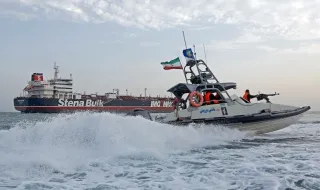
Iran will not open the Strait of Hormuz until seven conditions set by Tehran in the June agreement with the US are met, said the speaker of the Iranian parliament and Iran's chief negotiator in the talks with the US, Mohammad Bagher Ghalibaf, quoted by the Iranian news agency Nurnews.
His statement comes a few days after Tehran received Washington's response to Iran's seven-day plan to open the Strait of Hormuz.
"The Americans, who speak one thing to the media, recently presented proposals through a mediator. "However, they must understand that the time for delaying and imposing unilateral demands is over," Ghalibaf said.
He stressed that Iran's position is clear and firm.
"The Strait of Hormuz will not be opened until our seven conditions set out in the Islamabad Memorandum of Understanding are met," the Iranian parliament speaker said.
Iranian Foreign Minister Abbas Araghchi said separately that a plan proposed by Tehran to resolve the dispute with Washington could lead to the reopening of the Strait of Hormuz within seven days if adopted.
Araghchi told foreign ambassadors and diplomats in Tehran that Iran had clearly stated its conditions for opening the strait. According to him, they are bound by certain commitments that the United States must make.
Iran has presented the United States with a seven-day plan to open the Strait of Hormuz if certain conditions are met, Iranian Foreign Minister Abbas Araghchi told journalists on the sidelines of the UN General Assembly, quoted by American media.
“We presented the United States with a plan through intermediaries, according to which, if certain conditions are met, the Strait of Hormuz will be opened at the end of the seventh day and negotiations will resume“, Araghchi said.
He refused to specify the conditions, but said that they did not go beyond what was agreed between the two countries in June.
The proposal was conveyed to Washington through an intermediary, the “New York Times“ and CNN reported, quoted by DPA. A White House official told the television station that “positive and constructive talks through the mediators” were taking place.
Iranian state media reported that Araghchi had outlined Tehran’s conditions for opening the strait. These included immediately lifting the US naval blockade of Iran’s coast, releasing all frozen Iranian assets and ending the war on all fronts.
US and Iranian officials held talks on Tuesday on the sidelines of the UN General Assembly – the first such talks in months.
Control of the Strait of Hormuz, a key route for global oil and liquefied natural gas supplies, remains a key sticking point between Washington and Tehran.
Meanwhile, recorded commercial ship crossings through the strait fell to nine on Thursday from 14 on Wednesday, Reuters reported, citing preliminary shipping tracking data. Eight ships left the Persian Gulf and one entered. The average number of crossings over the past 10 days is 18.
The data does not include ships that may be passing with their transponders off. Before the war began on February 28, about 125 large commercial ships a day used to pass through the strait, and the route handled about a fifth of the world's crude oil and liquefied natural gas supplies.
The Bab el-Mandeb Strait recorded 26 crossings on Thursday, almost unchanged from the previous day, according to data from analyst firm Kpler.
The disruptions in supplies are also putting pressure on ship-to-ship oil transfers in the Gulf of Oman. According to trade sources and analysts quoted by Reuters, these operations have reached capacity after Saudi Arabia diverted exports from the Red Sea.
After the attack on the East-West pipeline on September 13, which halted exports from the port of Yanbu, “Saudi Aramco“ sold more than 60 million barrels of oil for transshipment between ships near Sohar, Oman, in September and October.
According to “Kpler“ data, Saudi crude oil exports through the Strait of Hormuz are expected to reach 3.6 million barrels per day in September, up from about 900,000 barrels per day in August. The increase is boosting demand for supertankers and driving up shipping costs.
The daily rate for chartering a very large crude oil tanker on the Middle East to China route reached a record $1.27 million on Monday, according to LSEG data.
According to the analytical company “Vortexa“, a cargo transfer operation between ships now takes nearly ten days, compared to five to seven days previously. The delays are directing buyers to alternative transhipment points off India and Malaysia or to direct deliveries to refineries.
Source: www.bta.bg