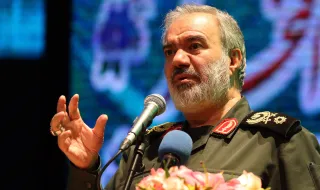
US forces have withdrawn more than 1,000 km from Iran's borders, said Ali Fadavi, commander of the Islamic Revolutionary Guard Corps (IRGC), an elite unit of the Iranian armed forces, TASS reports, quoted by News.bg.
"The Americans fled and withdrew more than 1,000 km from our borders. "This was not their choice, but the result of the influence of the Islamic Republic and the power of the IRGC ground forces," Fadavi said on state television.
According to him, for the first time, American ships are not present in the Persian Gulf, the Strait of Hormuz, the Sea of Oman and the northern part of the Indian Ocean. The commander stressed that the Strait of Hormuz has been under Iranian control for several months.
Fadavi also said that the United States has failed to achieve any of the goals it set during the war. He pointed out that Tehran, in cooperation with Muscat, has developed and implemented rules for shipping through the Strait of Hormuz, despite Washington's attempts to influence the situation in the region.
The IRGC commander also noted that due to insurance and financial obligations, captains are forced to use the southern part of the Strait of Hormuz. However, he warned that vessels passing through this route could "face action" by the Iranian armed forces at any moment.
He said that currently only 3-4 million barrels of oil are transported daily along the alternative route outside the zone designated by Tehran. According to Fadavi, this volume is significantly lower than the quantities transported before the war.
The United States and Israel started a war with Iran on February 28. In June, Washington and Tehran signed a memorandum of understanding that provided for an immediate cessation of hostilities on all fronts, including in Lebanon.
However, on the night of July 8, the United States resumed large-scale strikes against Iran, accusing Tehran of violating the terms of agreements related to the Strait of Hormuz.
The strait carries approximately 25% of the world's oil trade and about 20% of its liquefied natural gas trade.
Subsequently, the US administration effectively signaled an end to the use of large-scale military force against Iran. Instead, Washington turned to an attempt to economically strangle the country through sanctions.