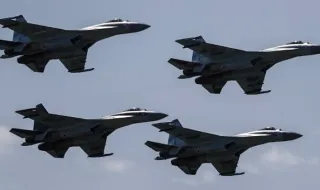
The incident in which Russian Su-34 and Su-35 fighter jets were attacked at the "Khanskaya" military airfield in the Republic of Adygea (Russia), suggests a shortage of air defense missiles in the country. This was stated on the air of Ukrainian Radio NV by Pavlo Narozhny, a military expert and founder of the "Reactive Mail" charity organization.
He noted that airports are usually seriously protected by air defense (ADF) systems, but the current situation reveals the lack of such at the location in question. According to Narozhny, if there was a real threat of the fighters being hit, they should have been lifted into the air and moved to other airfields or simply kept in the air.
"If this was not done, it is strongly assumed that these Su-34 and Su-35 were not airworthy - that is, parts were removed from them for other machines. They were practically just "gliders" - or, to put it more roughly, "carcasses" that were dismantled so that other aircraft could remain in service," explains Narozhny.
The expert points out that this situation also indicates the exhaustion of Russian air defense assets; in other words, Russia simply does not have enough missiles. "Absolutely all Russian military correspondents write about the shortage of missiles for air defense systems - specifically noting that systems like the "Pantsir" fire fourth-rate missiles that are dangerous for the operators themselves, and highlighting the serious problems with the repair of these "Pantsir" installations, added Narozhny.
Strikes on fighter jets in Adygea: what is known
On October 4, the Security Service of Ukraine (SBU) announced that two Russian fighter jets - Su-35 and Su-34 - were hit at a military airfield in Adygea. These aircraft are capable of carrying guided aerial bombs (UAB), which the Russian army uses massively against the front line and Ukrainian cities.
The attack was directed against the "Khanskaya" military airfield in the Republic of Adygea (Russia), where the aircraft in question were stationed. The distance to the target was approximately 500 kilometers.
Drones of the Special Operations Center "Alpha" of the Security Service of Ukraine (SBU) struck the following targets: a Su-35 fighter (a multi-role fighter, considered one of Russia's most advanced combat aircraft, with an export value of about $100 million); a Su-34 fighter-bomber (a key asset of Russian tactical aviation, with an export value of about $50 million); and an ammunition depot located at the airport.