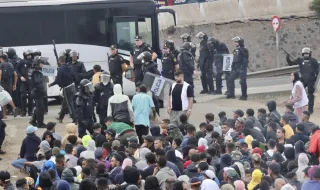
More than two-thirds of refugee and migrant children who reached Europe via the Mediterranean and Balkan routes in 2025 traveled without a parent or guardian, with many of them exposed to violence and exploitation. This is according to a new report by UN agencies, quoted by “Reuters“, reports News.bg.
Although the total number of children arriving in Europe by land and sea last year decreased by 25% compared to 2024, the share of unaccompanied children has increased significantly. It has increased from 51% in 2024 to 67% in 2025.
The data are presented in a joint report by the International Organization for Migration (IOM), the United Nations High Commissioner for Refugees (UNHCR) and UNICEF.
Of a total of 31,100 children who reached European countries in 2025, including Bulgaria, Cyprus, Greece, Italy, Malta and Spain, more than 20,000 were registered as unaccompanied or separated from their parents or guardians.
The largest share of these children is among those who arrived in Italy and Spain - 86%. In Italy, the total number of child arrivals increased by 12%, with a significant proportion of them being citizens of Egypt, Eritrea, Bangladesh and Somalia.
According to the report, poverty, armed conflict, as well as natural and climate risks are among the main reasons that push people to undertake dangerous journeys to Europe. However, limited opportunities for safe and legal migration appear to be forcing more and more children to use risky routes and rely on smugglers.
In parallel, the number of children included in refugee resettlement procedures in Europe has decreased significantly - from 8,900 in 2024 to just 3,400 in 2025.
Only 199 children were relocated from one European country to another under the EU Voluntary Solidarity Mechanism, a drop of 67%. None of these children were unaccompanied.
The mechanism was introduced in 2022 and allows European countries that host large numbers of migrants and asylum seekers to voluntarily transfer some of them to other countries participating in the mechanism.
“This report shows how vulnerable children are to violence and exploitation when safe routes are limited and they are forced to rely on smugglers“, said IOM Director-General Amy Pope.
She called on European countries and countries along migration routes to strengthen their cooperation in combating criminal networks that exploit minors.
Particularly worrying are the results of interviews with more than 4,600 young people aged between 15 and 24 who travelled along the Mediterranean, West African, Atlantic and Western Balkan routes route.
Nearly half of those surveyed said they had experienced physical violence. In many cases, this involved more than one form of violence, including torture and kidnapping during the journey and when crossing borders. The report also cited evidence of forced labor.
Libya was the country most frequently cited by interviewees as a place where migrants had been subjected to violence and other abuses.
Around one in ten respondents who used the Eastern Mediterranean route said they had been lured by promises of well-paid work, safe travel or legal documents to cross borders.