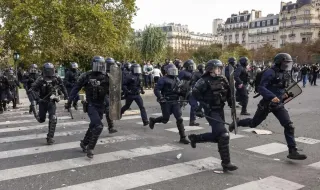
Student protests have blocked hundreds of high schools in France and brought demonstrators to the streets of Paris, Lille, Rennes, Nantes, Toulon and Marseille. The movement has been going on for three weeks and is caused by a shortage of teachers, overcrowded classrooms, the poor condition of school buildings and a busy curriculum.
According to the French Ministry of Education, 224 schools were blocked in the morning, and by noon the number had decreased to 157. At the same time, 96% of educational institutions remained open. The Associated Press reported 375 schools that were fully or partially closed on Thursday, as well as more than 6,600 arrests since the protests began. The difference is related to the different reporting of fully and partially interrupted educational activities.
Most of the demonstrations have been peaceful, but clashes have occurred in some places. In Paris, police used tear gas to block a high school, and in Rennes, law enforcement officers resorted to water cannons. Since the beginning of the protest movement, there have been hundreds of arrests and dozens of injuries, Reuters reports. The French government temporarily stopped the use of flashbangs in the security of protests after a teenager lost his hand in an accident with such a device.
Students demand concrete solutions
Protesters are demanding the appointment of more teachers, improved facilities, reduced workloads and better learning conditions. In France, it is not unusual for high school students to have classes from 8 a.m. to 6 p.m., followed by a significant amount of homework.
In Marseille, 28-year-old teacher Diane de Choulot, who teaches a class of 37 this year, joined the march. “At the beginning of each lesson, I have to ask them to check the neighboring classrooms for empty chairs and desks so they can study at all,“ she said. The teacher carried a poster that said her students were helping her catch cockroaches in the classroom.
Education Minister Edouard Geoffrey announced after a meeting with students and teachers in Reims that an emergency plan to replace absent teachers on a long-term basis was being implemented. He said a review of the curriculum was also being discussed. Geoffrey also announced that possible changes are being prepared for the national Parcoursup platform for applying to higher education institutions, which is often criticized as complicated and burdensome for prospective students.
Government promises measures by the end of October
Prime Minister Sébastien Lecornu promised that the government would present “concrete, rapid and fully funded solutions“ by the end of October. He did not provide details, which did not satisfy the organizers of the protests.
“Our demands must be heard. Yesterday, Mr. Lecornu told us a lot of empty words,“ said Riad Rani, head of one of the student unions. Organizers announced new marches on Tuesday, and calls for nationwide protests on October 17 are circulating on social media.
According to an Elabe survey for BFM TV, 72% of French people believe the students' demands are legitimate, but 55% believe the demonstrations should be stopped. The tension has left the government facing a choice between greater investment in education and restrictions related to the budget deficit and public debt.
The protests have also spread to Belgium. There were demonstrations in Brussels, Sines and Liege, where authorities banned public gatherings of more than three people until October 16. However, police allowed a demonstration in front of the local university.
Sources: investing.com, apnews.com