The Russian Ministry of Education plans to introduce a state-controlled television service in schools in Russia and in the occupied Ukrainian territories in 2027. Meanwhile, Russian forces claim to have evacuated over 4,000 Ukrainian civilians from frontline settlements in the Donetsk region. In parallel, the occupation administration in Mariupol continues its policy of confiscation and redistribution of housing.
These developments were reported by the Institute for the Study of War (ISW), which examines the actions of the Russian authorities in the context of the deepening administrative, political and ideological integration of the occupied Ukrainian territories.
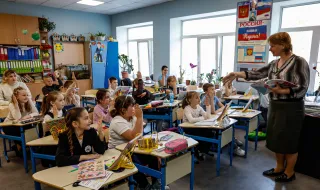
State television in schools from 2027.On September 30, Russian Education Minister Sergei Kravtsov said that the ministry plans to create a unified television service for all schools in Russia and occupied Ukraine.
The program will include educational films and videos that will be broadcast both during school hours and during breaks. Initially, the service will be introduced in 15 pilot regions, the names of which have not been specified. In 2027, it is planned to cover the rest of Russia and the occupied Ukrainian territories.
According to ISW, the Russian Ministry of Education has already established control over all aspects of the education system in the occupied regions. The introduction of a single state-controlled television service would allow for the further spread of pro-Russian ideologies among schoolchildren.
Influence on children from preschool ageThe occupation leadership of the Zaporizhzhya Nuclear Power Plant organizes educational initiatives among children, including in kindergartens, in order to promote professional realization in the Russian nuclear industry.
The Russian state nuclear power plant operator “Rosenergoatom“, which controls the Zaporizhzhya NPP, has been deeply integrated into the school system and social structure of Energodar since 2022.
According to the ISW assessment, these activities support efforts to militarize Ukrainian children from preschool age and to direct them towards a future career in the Russian nuclear industry.
Over 4,000 civilians have been evacuated, according to MoscowRussian forces claim to have evacuated more than 4,000 Ukrainian civilians from frontline settlements in Donetsk region. The Russian Defense Ministry said the people were taken to an unspecified “safe zone,” likely located further inside the Russian-occupied part of the region.
On September 29, Russian Senator Natalia Nikonorova, a member of the Federation Council’s International Affairs Committee, told TASS that the deported civilians had begun procedures to obtain Russian citizenship soon after arriving at the shelters.
ISW warns that such population transfers during wartime could facilitate the administrative and political integration of the occupied territories in a way that raises concerns under international law.
The institute has previously assessed that Russia is using such centers for so-called "filtering" of Ukrainian civilians. According to this assessment, Ukrainian citizens are effectively detained at the sites, questioned about their possible loyalty to Ukraine, and then administrative procedures are initiated to relocate them further into the occupied territories or to deport them directly to Russia.
The initiation of procedures for obtaining Russian citizenship immediately after the evacuation suggests that Moscow may view these operations not as a temporary population transfer, but as the beginning of a long-term process of transforming Ukrainian citizens into Russian citizens.
Confiscation and redistribution of housing in MariupolMeanwhile, the occupation administration's policy of confiscation and redistribution of housing in Mariupol continues to deprive Ukrainian residents of their rights to real estate.
Photos from October 1 show another case that ISW believes is not an isolated incident, but part of a broader trend of confiscation and redistribution of apartments in occupied Ukraine. This practice is particularly pronounced in Mariupol.
The occupation authorities declare certain properties “ownerless“ based on criteria that are often abstract. These include the lack of updated real estate documents according to Russian standards or unpaid utility bills.
The property is then entered in the register of “ownerless properties“. From that moment on, the owner has 30 days to appear in person and prove his or her right to ownership.
If the procedure does not result in recognition of ownership, the dwelling is included in the municipal housing stock. It can then be redistributed through the so-called “compensation queue“, with priority given to Russian citizens or individuals loyal to the occupation regime.
According to ISW analysis, these practices, along with educational initiatives and the relocation of civilians, are part of Russia's broader efforts to consolidate its control over the occupied Ukrainian territories and their populations.