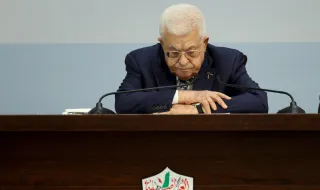
The Palestinian Authority intends to postpone the parliamentary elections, scheduled for November 28, 2026, due to the deteriorating political, economic and security situation. This is clear from a letter from Palestinian Vice President Hussein al-Sheikh to French Foreign Minister Jean-Noel Barrot, which „Reuters“ has become acquainted with, News.bg reports.
The document dated October 8 states that the conditions on the basis of which the election date was set have not been met. According to the Palestinian leadership, the current situation calls into question the ability to guarantee universal participation, free voting and a fair electoral process.
The postponement comes against the backdrop of the war and destruction in the Gaza Strip, Israeli military operations and restrictions on movement in the West Bank, as well as the continuing division between the main Palestinian movements.
The Palestinian Authority was established in 1994 as an interim administration under the Oslo Accords between Israel and the Palestine Liberation Organization. It is planned to gradually take over the administration of parts of the West Bank and Gaza before the final status of the Palestinian territories is agreed. However, a final political settlement has never been reached.
The last parliamentary elections were held in January 2006. At that time “Hamas“ won 74 out of 132 seats, while Mahmoud Abbas's Fatah movement won 45. The ensuing conflict between the two organizations escalated into armed clashes, after which Hamas took control of Gaza in 2007.
In 2021, Abbas again scheduled parliamentary and presidential elections, but postponed them, arguing that the Palestinian vote in East Jerusalem could not be guaranteed. His political opponents accused him of trying to avoid elections in which Fatah could lose.
Abbas remains in power after his term expiresThe 90-year-old Mahmoud Abbas was elected president in January 2005 with about 62% of the actual votes. His four-year term expires in January 2009, but no presidential elections have been held since.
The PA leadership justifies its continued rule by the need for institutional continuity and the impossibility of organizing elections under the current conditions. However, its critics accuse it of concentrating power and weakening democratic institutions.
In 2025, Hussein al-Sheikh, a long-time high-ranking representative of “Fatah“ and one of the main mediators in contacts with Israel, was appointed vice president.
Limited powers and public distrustThe Palestinian Authority does not have full state sovereignty. Its powers in the West Bank are limited by agreements with Israel, which retains control over security and territorial planning in Area C - about 60% of the territory. The PA does not have its own army and does not independently control its external borders and airspace.
Its financial stability also depends on taxes and duties collected by Israel on its behalf. The withholding or delay of these funds periodically leads to severe budgetary difficulties.
Abbas rejects armed struggle as the main path to Palestinian statehood and supports a diplomatic solution to the conflict. At the same time, the PA maintains security coordination with Israel - a policy that arouses distrust among parts of Palestinian society.
A survey by the Palestinian Center for Political and Sociological Studies from September 2023 shows that 78% of respondents want Abbas to leave office. An Arab Barometer survey published in January 2026 reported only 13% support for him in a hypothetical presidential race in Gaza.
A new delay without a clear outcomeThe Palestinian Authority remains an internationally recognized institutional partner in negotiations over the future of the Palestinian territories, but the lack of regular elections and the division between “Fatah“ and “Hamas“ call into question the public legitimacy of its government.
Organizing a vote is also hampered by real obstacles, especially in Gaza and East Jerusalem, where there are serious security and logistical problems.
If the elections are postponed, Palestinians will again fail to elect their parliamentary representatives on the previously announced deadline. Thus, almost 20 years after the last parliamentary vote, the crisis over the legitimacy of the institutions in Ramallah will continue, and the question of the future of autonomy and the transition to Palestinian statehood will remain unresolved.