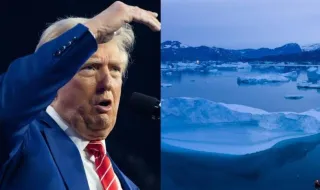
Donald Trump said that global warming has not been confirmed because the planet is cooling and ice has reached record levels. The public transcript shows that this statement was made on October 1, 2026, during a visit to a “Peterbilt“ plant in Denton, Texas, and not at a rally in Syracuse, New York, on October 9.
“It didn't happen because the planet was cooling. In fact, the ice that was melting right now is setting a record. "This is the biggest ice cube in the history of the world," Trump said.At the rally in Syracuse, the president appeared to support Republican candidate for governor of New York Bruce Blakeman. Public records from the event do not confirm that Trump repeated those exact words there. The difference is significant, as the original claim linked the quote to a different city and a different date.
What climate measurements show
The data does not support the conclusion that the Earth has begun to cool. The World Meteorological Organization has identified the period 2015-2025 as the 11 warmest years on record. The organization said 2025 was the second or third warmest year on record, with the global average temperature about 1.43 degrees Celsius above the 1850-1900 level.
NASA also reported that 2024 remained the warmest year on record. The agency said 2025 was slightly warmer than 2023, although the difference between the two years was within statistical uncertainty. The U.S. National Oceanic and Atmospheric Administration ranked 2025 as the third warmest year on record.
Ice shows no sign of reversing trend
The upper ocean contained a record amount of heat in 2025. NOAA also reported that the average Arctic sea ice extent was the second-lowest in 47 years of satellite records, and the annual maximum was the lowest in the entire period. The World Meteorological Organization said that glaciers are melting and Antarctic sea ice was the third-lowest on record.
In March 2026, the National Snow and Ice Data Center reported a new record low for Arctic sea ice, statistically tying the previous record. This does not rule out temporary regional increases in ice or the emergence of large icebergs, but such isolated events are not evidence of global cooling. Long-term measures of temperature, ocean heat, sea ice and glaciers suggest otherwise.
Sources: rollcall.com, washingtonpost.com, cbsnews.com