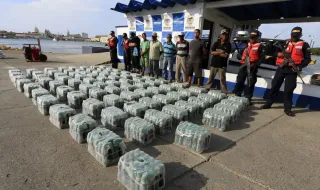
The US military campaign against suspected drug traffickers has failed to halt the growth of cocaine production and trafficking, writes “Wall Street Journal“. More than 13 months after the operation began, traffickers are changing their routes, using new types of vessels and rerouting shipments through river networks and cargo ships.
The first US strike was carried out on September 2, 2025. According to US officials, US drones and aircraft destroyed more than 70 vessels, killing nearly 240 crew members in the attacks. Washington estimates the value of the cocaine destroyed at $1.5 billion.
President Donald Trump said in June that maritime drug trafficking to the United States had dropped by 97 percent. However, the data cited by the publication shows that shipments continue on a large scale.
Traffickers change routes
In the Colombian Pacific port of Buenaventura, navy divers are increasingly finding so-called “parasites” - metal modules filled with cocaine and attached to the hulls of cargo ships. Other shipments are transferred to fishing boats, containers and semi-submersibles.
In the Amazon region, drug traffickers are redirecting cargo eastward. The shipments are hidden in boats that carry food, fuel and other goods on the Caquetá and Putumayo rivers. Along the coast, crews are moving close to shore in the same type of fast boats that are the target of U.S. strikes.
“The boats keep leaving. The Pacific is vast,“ said Ervin Norsa, a former police investigator and drug trafficking researcher at the University of Rosario in Bogota.According to Felipe Botero of the Global Initiative Against Transnational Organized Crime, the campaign encourages traffickers to spread their shipments across multiple routes and vehicles, rather than relying on a small number of large operations.
Colombia's Production Continues to Grow
Colombia produces about 70 percent of the world's cocaine. According to the Ideas for Peace Foundation, clandestine labs produce more than 3,300 tons a year, and the number of armed groups involved in drug trafficking has reached about 28,000.
The record quantities are pushing down prices. In Miami, a kilogram of cocaine sold wholesale for about $16,500 in the summer, below the historical range of $22,000 to $25,000. In some European cities, the price has fallen to around $16,000 per kilogram, and the purity sometimes reaches 98 percent.
France seized a record 92 tons of cocaine in 2025, which is 204 percent more than in 2022. Traffickers have begun to avoid large ports and use smaller terminals, as well as routes through West Africa.
The American strikes may increase the cost and risk for individual crews, but according to experts quoted by the “Wall Street Journal“ they do not affect the main factor - the huge international demand. Thus, the campaign changes the way cocaine moves without stopping its production.
Sources: wsj.com, occrp.org