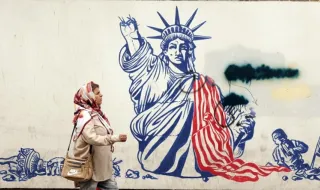
Women in Iran can increasingly be seen on the streets without the hijab - this is one of the biggest social changes in the country since the protest movement "Women, Life, Freedom" in 2022. It began after the young Iranian woman Gina Mahsa Amini died in custody after being sent there for violating the rules on wearing the hijab.
The authorities have not been able to restore the level of control on the streets that existed before the protests. But the relative withdrawal of patrols by the so-called "morality police" does not mean that wearing the hijab is no longer mandatory. Now, authorities and conservative groups are experimenting with different ways to oppose the change, without necessarily provoking the same street clashes that helped ignite the 2022 protests.
Judiciary Chief Gholamhossein Mohseni Ejei recently called for action against what he described as social “anomalies,” “indecency,” and “nudity,” urging prosecutors to coordinate with police, intelligence, and state institutions.
Meanwhile, supporters of mandatory hijab have been running online campaigns encouraging people to avoid businesses run by women who do not adhere to the state dress code and instead support women who do. The result is a more fragmented form of law enforcement, which in some cases moves from police patrols to workplaces, businesses and access to everyday services.
The regime raises the social price
A lawyer in Tehran told DW that such campaigns risk deepening social divisions in Iran, rather than encouraging compliance with a social norm. “This is a deliberate attempt to categorize people according to their identity and pit them against each other,” said the woman, who asked not to be named for safety reasons. In her opinion, promoting economic pressure against people solely because of their appearance goes beyond the right of each individual to choose where to shop.
“When economic sanctions are imposed on the regime, they call it pressure, injustice and economic warfare,” she said. “But when they use the same logic internally to force a section of society to change its behavior, that is already “supporting values.”
The lawyer challenged the assumption that women who adhere to a particular dress code uniquely represent Iranian social values. “The reality of Iranian society is much more complex than that,” she said. Posts by Iranian women suggest that the enforcement of the dress code can manifest itself elsewhere, with some women reporting on social media that they were denied access to clinics and banks because they were not wearing a headscarf.
The female body as political
Shirin Shams is an exiled Iranian political activist and director of the “Women's Revolution” Organization, which advocates for a secular state and human rights in Iran. She told DW that the latest campaigns targeting women who refuse to wear the compulsory hijab are an attempt to revive social divisions that were weakened during the “Women, Life, Freedom” movement. “The Islamic Republic has been trying to divide women for years based on their clothing,” said the activist, who lives in Germany.
She describes the compulsory hijab as one of the most important ideological lines of the Iranian state and argues that the widespread presence of women without headscarves shows how far social reality has gone beyond official expectations. She says the renewed campaigns are an attempt to restore the line between women who obey and those who do not.
Said Paivandi, a professor at the University of Lorraine in France, argues that the conflict reflects a broader struggle for social control. According to him, Iranian authorities have for years made a distinction between women considered “properly” dressed and those officially defined as “poorly covered” or “uncovered”. “The government is once again turning women’s bodies into a social and moral issue, even a security issue,” said Paivandi. A woman without a headscarf is not simply perceived as someone who has made a personal choice, he explains. For some in the political elite, it can also represent a visible challenge to the ideological order.
Iran’s hardliners versus modern reality
Although Iranian President Massoud Pezeshkian has repeatedly spoken of social cohesion and national unity, conservative figures in the judiciary and political sphere continue to demand stricter enforcement of the dress code. This creates instability and exposes divisions within the Iranian political elite.
Some of the elite seem to realize that a return to large-scale clashes between police and women could lead to significant social and political problems. Others, however, are reluctant to accept the normalization of women appearing without the hijab in public. The result is neither the old system of comprehensive enforcement of street rules nor the end of mandatory dress codes. Instead, pressure can be exerted intermittently through courts, workplaces, businesses, administrative procedures, and social campaigns.
Enforcing the rules without the morality police
Paivandi believes that direct enforcement has reached its limits, and that supporters of Islamic dress codes are looking for alternative ways to enforce compliance. This could shift some of the burden from state institutions to society itself. A bank employee, a clinic receptionist, an employer, a shopkeeper, or a customer can all become involved in enforcing standards even without a police officer present. This blurs the lines between law, personal judgment, and ideological pressure.
Paivandi warns that associating religion with humiliation, exclusion, and coercion could further alienate younger Iranians from religious institutions. Women who choose to wear the hijab can also be drawn into a confrontation they did not choose, he adds: for example, if their attire is presented as a sign of political loyalty.
Source: www.dw.com