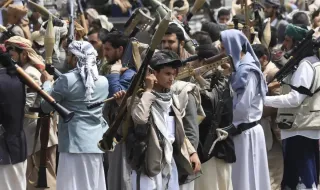
Yemeni government forces are continuing their offensive against Houthis, but missile strikes and the loss of key supply routes are putting Operation Yemen Dawn under serious pressure. At least five people were killed in a strike near the presidential palace "Al-Maashqiq" in Aden. Prime Minister Shaya al-Zindani was inside the palace but was unharmed.
Houthi military spokesman Yahya Sari said the target was an operational headquarters linked to Saudi-backed forces and equipment of the internationally recognized government. The attacks coincide with a Houthi offensive around Taiz in the southwest of the country.
Moha remains in Houthi hands
In early September, the Houthis captured Moha, a Red Sea port and a key logistics hub for government forces in western Taiz province. A counteroffensive that followed has recaptured some of the territory lost, but not the city itself.
The disruption of routes is making it difficult to deliver ammunition, reinforcements and fuel. The main road between Taiz and Aden is blocked, and alternative routes through the mountains are also disrupted. Taiz is effectively under siege, with the price of gasoline in the city tripling in the past week.
Colonel Waddah al-Dubaish, a spokesman for the government-backed Joint Forces on the West Coast, said the Houthis could slow down supplies and increase costs, but not stop them altogether.
“The Houthi group is constantly trying to cut off supply lines to government forces, but it has not been able to stop these supplies. Military operations against the Houthis will continue,” al-Dubaish said.Supply is divided into separate sectors
Government forces are fighting simultaneously along the southern Red Sea coast, around Taiz, and in the Marib and Al-Jawf areas, east of Sanaa. Deputy Justice Minister Faisal al-Majidi described the strategy as “logistical flexibility and decentralization.”
According to him, supply routes are divided into relatively self-contained sectors that rely on nearby access points and hubs in Shabwa, Marib, the Taiz governorate, the Red Sea coast and the southern provinces. Forces are also seeking to seize heights above the main roads to protect the routes from shelling.
Among the priority areas is the mountainous Al-Waziya in Taiz province. It overlooks the coast and could be used to try to relieve the siege of the city from the west. Fighting continues there.
Saudi support and the problem of command
Saudi Arabia has increased its support for the government and allied forces since the start of Operation “Yemen Dawn”. For the first time since the 2022 ceasefire, Riyadh has confirmed airstrikes against the Houthis. The Saudi-led coalition says it has destroyed hundreds of high-value targets since the beginning of October.
Al-Dubaish defines Saudi military aid as crucial, as the Houthis have ballistic and cruise missiles supplied by Iran, as well as a large number of fighters. According to al-Majidi, air support should cut off the movement of reinforcements and destroy missile and drone launch sites.
The other major test is coordination between anti-Houthi forces. Colonel al-Dubaish acknowledged that the various military formations continue to operate under separate command structures. In January, the Presidential Leadership Council established a Supreme Military Committee to unify the units under a single command.
Yemeni researcher Adnan al-Jabarni believes that coordination is gradually improving, but the loss of parts of the Red Sea coast has shown how difficult it is for the different forces to respond together. For Taiz, the crucial question remains whether government forces will be able to regain their roads and maintain access to the frontlines.
Sources: aljazeera.com