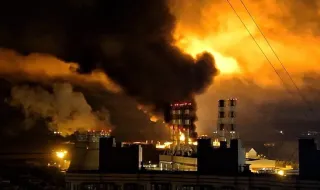
The St. Petersburg Oil Terminal was among the sites hit in a massive drone attack on St. Petersburg and the Leningrad Region overnight. A fire broke out on its territory, St. Petersburg Governor Alexander Beglov said. According to regional governor Alexander Drozdenko, at least 144 drones were shot down over the region. There were no reports of casualties in the attack.
“Currently, the Emergencies Ministry forces are extinguishing fires at civilian infrastructure sites, including on the territory of the St. Petersburg Oil Terminal,“ said Beglov.
There is currently no public confirmation of tanks, berths, rail links or pumping stations destroyed. No official suspension of loading and unloading operations has been announced. This means that the fire itself does not allow us to conclude that the entire complex was fatally damaged.
What is the terminal?
The St. Petersburg Oil Terminal is located in the area of the Grand Port of St. Petersburg and is one of the largest Baltic complexes for handling liquid cargo. It receives, stores and tranships petroleum products, bunker fuels, vegetable oils and other liquid cargoes. The terminal is not a refinery and does not process crude oil.
Its infrastructure includes 32 tanks with a total capacity of about 441,000 cubic meters. Its design capabilities allow for the reception and loading of approximately 1.1 million tons of petroleum products per month. The complex has four berths for tankers with a deadweight of up to 100,000 tons and a separate berth for bunkering vessels.
What is the actual volume of work
According to data cited by “Fontanka“, in 2025 the St. Petersburg Oil Terminal processed about 5.29 million tons of cargo. This is a decrease compared to 6.38 million tons in 2024 and shows that the actual annual cargo turnover is significantly below the projected monthly maximum.
A separate estimate by Argus indicates that in January-September 2025, about 2.15 million tons of petroleum products were exported through the terminal. This value does not contradict the annual cargo turnover, as it measures only seaborne exports, while the total turnover also includes other operations, domestic deliveries and various categories of liquid cargo.
Strategically important, but not indispensable
The terminal is of strategic importance for the northwestern logistics of Russia, as it connects rail and road deliveries with sea exports via the Baltic Sea. Damage to tanks, railway trestles or berths could delay loading and force some of the flows to be redirected to other ports.
At the same time, the St. Petersburg oil terminal is not the only and not the largest Russian crude oil export hub. Its importance is greater in oil products and storage than in direct crude oil exports. Therefore, a single fire may lead to temporary restrictions, but does not automatically mean the paralysis of Russian oil exports.
The results of the inspection of tanks, pipelines and ship berths will be decisive. Until this data is published, the most accurate conclusion is that the terminal was hit and a fire broke out, but there is no confirmation of damage that would make its operation impossible.
Sources: fontanka.ru, dp.ru, view.argusmedia.com