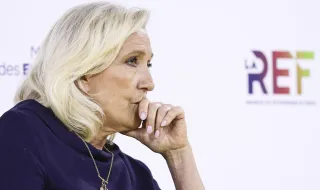
In France, the leader of the “National Rally“ Marine Le Pen is among the favorites in the surveys for next year's presidential elections. In Germany, the “Alternative for Germany“ (AfD) is increasingly confident of the possibility of dominating the Bundestag, especially after its victories in the recent regional elections in Saxony-Anhalt and Mecklenburg-Western Pomerania, reports News.bg.
And since both Le Pen and the AfD are often described as pro-Russian, warnings are already being heard that the Franco-German “engine“ of the European Union may soon be governed by “kopecks“, “Russian assets“ and other similar figures.
However, how well-founded are these concerns?
To answer this question, we need to examine public attitudes and political positions towards Russia in France and Germany, as well as compare them with those of the Bulgarian party “Vazrazhdane“ - an indisputably pro-Russian political entity in today's Bulgaria.
Marine Le Pen: from historical ties with Moscow to criticism of Russian aggression
Sympathy for Russia, and before that for the USSR, has a long history in French society. Since the end of the 19th century, various social and political circles in France have shown interest in Russia for various reasons: the Franco-Russian alliance before and during the First World War, the influence of the Russian White emigration after the October Revolution, the traditionally strong positions of the French Communist Party and “Gaulism“ from the Cold War era.
The latter is based on the understanding that France must maintain independence and balance between the two superpowers - the USA and the USSR.
However, these attitudes should not be equated with traditional Bulgarian Russophilia. The French version does not imply unconditional worship, admiration or gratitude to Moscow. From the position of their nationalism, the French, or at least the indigenous inhabitants of France, would hardly put Russia above their own country. Rather, it is perceived as one of the more acceptable geopolitical forces compared to others.
Marine Le Pen herself is the chairwoman of the parliamentary group of the “National Rally“ - a party founded in 1972 under the name “National Front“ and led for decades by her father Jean-Marie Le Pen.
“National Front“ is a classic far-right formation, around which nationalists, veterans of the Algerian War and even, while there are still living representatives, functionaries of the Vichy regime unite. Among them are former members of the French Waffen-SS division “Charlemagne“.
In such a political environment, pro-Soviet sentiments would hardly find a foothold. After the collapse of the USSR, however, “National Front“ gradually began to improve its relations with Moscow. Opportunities for strategic alliances with Russian nationalists such as Vladimir Zhirinovsky, united by the desire to oppose globalism dominated by the United States, emerged.
This line continued under Marine Le Pen, who took over the leadership of the party in 2011. In 2018, the formation adopted the name “National Assembly“.
In 2014, the party received a loan from a Russian bank. In the interest of objectivity, however, it should be noted that this was after all French banks refused to lend to it and years before the start of the Russian “special military operation“ in Ukraine.
In 2017, when she was a candidate for president of France, Marine Le Pen was personally received by Vladimir Putin in the Kremlin.
The Russian invasion of Ukraine gradually changed her attitude towards Moscow. Le Pen condemned the Russian military aggression, but at the same time criticized the sending of weapons to Ukraine and the economic sanctions related to energy. Her argument is that such measures harm the interests of French citizens.
In September of this year, Le Pen and the current chairman of the “National Assembly“ Jordan Bardella went so far as to come up with a particularly harsh position against Russian hybrid attacks against France.
Nevertheless, Marine Le Pen continues to be regularly described as a “Russian asset“. The reasons are as in some of her previous positions, which she subsequently renounced – leaving the EU and returning to the French franc, – and in her current views. These include criticism of Schengen in its current form, the desire for France to leave the military structure of NATO, and calls for the lifting of sanctions against Russia.
„Alternative for Germany“: economic pragmatism and rapprochement with Moscow
Historical prerequisites for Russophile sentiments in Germany can be found among some of the political and intellectual elite, including due to dynastic connections in the past and cultural influence. However, the picture is different among the population.
Especially in the eastern German provinces, memories of the atrocities of the Red Army at the end of World War II, as well as the Soviet occupation zone, which later became the German Democratic Republic (GDR), have been preserved.
It is in these provinces that the “Alternative for Germany“ has more serious electoral positions.
At the same time, Germany's historical guilt for Nazism and World War II deters both extreme Russophobia and war rhetoric of the type of “hawks“ towards Moscow.
A telling example is the “Eastern Policy“ of the West German Chancellor Willy Brandt from the late 1960s. According to it, the democratization of the Eastern Bloc can be achieved not through confrontation, but through rapprochement with the Soviet Union. The main idea is that security in Europe is impossible without Russia.
„Alternative for Germany“ was founded in 2013 as a strongly pro-market and libertarian party. Soon after its establishment, however, it placed opposition to migration at the center of its political program.
Like the „National Assembly“, the AfD is defined by observers as part of the far-right political spectrum. One of the reasons is that both formations belong to European political families, located to the right of the European People's Party (EPP). „National Assembly“ is a member of the “Patriots for Europe“, and the “Alternative for Germany“ – in the “Europe of Sovereign Nations“, where the Bulgarian “Vazrazhdane“ is also a member.
The AfD's economic program combines elements of market radicalism, national protectionism and Euroscepticism. Among its main proposals are limiting the role of the state, low taxes, rejection of the euro, rejection of the Green Deal and policies to combat climate change, which the party defines as insane, as well as limiting access to the German labor market for migrants from non-EU countries.
These messages find support among the population of the poorer eastern provinces. Although 2 trillion euros have been invested in them since German reunification - before the introduction of the euro, their equivalent in German marks, - they still fail to reach the western provinces in terms of economic development and living standards.
For comparison, the economy of Saxony-Anhalt, where the AfD recently won the Landtag elections, is at the level of the Sofia-city district.
However, the party's economic pragmatism is also manifested in its desire to restore energy ties with Russia. Because of its desire for Germany to import cheap Russian raw materials again, the AfD opposes European economic sanctions against Moscow.
In this sense, the “Alternative for Germany“ fits more into the notion of a “Russian asset“. The party insists on ending aid to Ukraine, lifting sanctions against Russia and taking a highly critical stance towards NATO.
It even came to investigations against AfD MEPs on suspicion of funding from a pro-Russian disinformation network.
„Vazrazhdane“: why the Bulgarian case is different
Much has been written about the historical Russophilia in Bulgaria. There are several reasons for it.
Even during the Vazrazhdane, vigilant Bulgarians, including Hristo Botev and Stefan Stambolov, received education in the Russian Empire. Russia has undeniable merits for the Liberation of Bulgaria, the restoration of Bulgarian statehood and the establishment of modern Bulgarian institutions.
Similar to France, white emigration is settling in our country. To these historical prerequisites, one must add the communist regime, which exploited the role of Russia and the USSR to the extreme.
Thus, the public environment in Bulgaria turns out to be different from that in Germany, for example.
While “Alternative for Germany“ can be defined as a situationally pro-Russian formation, “Vazrazhdane“ is an outright Russophile party. This is true regardless of the similarities in the rhetoric of the two formations regarding the war in Ukraine, the sanctions against Russia and the role of NATO in European security.
“Vazrazhdane“ openly praises and promotes the regime in the Kremlin. AfD, and even more noticeably Marine Le Pen, are significantly more restrained in this regard. It is also significant that Russian flags are not flown at demonstrations of either the “National Assembly“ or the “Alternative for Germany“.
Two speculative assumptions about “Vazravdane“ can be made here.
The first is that the party may be a project of the Bulgarian services, the aim of which is to keep the Russophile vote under control. Is it noticeable that despite the pro-Russian rhetoric of Kostadinov and his party members, there has been no real benefit for the Kremlin so far?
All the money is going to the whistle. Even the referendum against the introduction of the euro was failed. It can even be predicted that if Bulgaria ever really moves towards leaving the EU, Kostadin Kostadinov will fail the procedure and the country will remain in the Union.
The second assumption is that the leader of “Vazrazhdane“ has simply occupied the already existing Russophile electoral niche. The logic is simple: with or without him, there will be people in Bulgaria who wave Russian flags and put Russia above their own country. If they don't follow Kostadinov, they will probably follow someone else.
As a historian, he cannot help but know that Russophilia in Bulgaria is based much more on mythology than on facts. However, this does not prevent him from “selling hopes“. And fears.
Can Europe become a vassal of Moscow?
Let's return to the Franco-German engine of the EU. If in the near future pan-European policy begins to be determined by Marine Le Pen and Alice Weidel, the chairwoman of “Alternative for Germany“, does this mean that Europe will become a vassal of Moscow?
Such a scenario seems far-fetched.
Indeed, under the current circumstances, some rapprochement with Russia can be expected. However, it would be more reminiscent of the period of "detente" during the Cold War than unconditional submission to the Kremlin.
Marine Le Pen could hardly become a French "kopeck piece". In a society like France, the xenophobia characteristic of some Bulgarian political attitudes is practically unthinkable.
“Alternative for Germany“ seems closer to the Russian orbit, but here too there is an important nuance. The party seeks to restore the ruined German energy sector - a state for which, according to this thesis, the political forces that today demonstrate the strongest anti-Russian position in Germany are responsible.
However, the removal of carbon quotas and the possible resumption of nuclear energy are not in Moscow's long-term interest. It is more profitable for Russia for Europe, and Germany in particular, to be weak in terms of energy and dependent on Russian supplies.
There is another important point that is often left out of the debate: both the “National Assembly“ and the “Alternative for Germany“ are anti-immigrant parties.
Migration is among the most serious problems of modern Europe. Therefore, the question arises whether the political forces that oppose it are not actually working against Russian plans to make European countries weak and subordinate.
It is this contradiction that shows why the label “pro-Russian“ is not always sufficient to explain the political goals of a given party. There are significant differences between historical sympathies for Russia, economic pragmatism, Euroscepticism, and unconditional support for the Kremlin that should not be ignored.