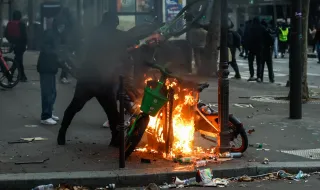
Nicolas is shocked by the sight: his favorite cafe has been destroyed, completely burned down. The Frenchman condemns the violence, but supports the social protests. He does not understand why the media only talk about the riots, but practically pay almost no attention to the fact that in many cities in France people protested peacefully. "These are demonstrations where young people are fighting for their rights. These are people who have been facing enormous difficulties for years because of Emmanuel Macron's policies," Nicolas tells the German public broadcaster ARD. For him, it is "a symbol of a society in a bad state that is suffering".
"How could the French do such a thing to France?"
In an extraordinary televised address, French President Emmanuel Macron appeared relatively restrained in light of what has been happening in French cities in recent days. But when it comes to determining responsibility, he is categorical: "Inciters from far-left groups, together with criminals, committed unbridled violence in our cities. How could the French do such a thing to France? Nothing can justify, explain or excuse such behavior," Macron said. "Today we all feel anger and shame", he added.
The French president assured that strict measures would be taken against the perpetrators and did not even rule out the possibility of banning the demonstrations: "Given the current situation, the prefects, together with the mayors, will take decisions to protect our cities, public buildings and shops, and if necessary, they will even go so far as to ban certain gatherings and take all necessary measures".
To the young people, who have been taking to the streets for weeks with demands for better conditions, Macron did not commit to any specific concessions, but promised them greater participation in decision-making. And with a view to the presidential elections in the spring of 2027, Macron warned against taking the election campaign to the streets. "Those who want to convince you that it is necessary to organize demonstrations and provoke riots have only one goal: to monopolize the debate and harm the republic," he said, addressing the French public.
Who benefits from the riots?
Macron and the French government accuse the far-left "France Insubordinate" (LFI) of inciting the protests and using violence to extract political capital. The party's leader, Jean-Luc Mélenchon, in turn blames the government for the escalation. "We have a choice between a people and its youth who are in a deep crisis - moral, psychological and economic - and a government that always relies on the same strategy: to watch the situation deteriorate, then to apply blind violence and sow fear", Mélenchon said on television.
A few hours before Macron's speech, Marine Le Pen also published a video address - full of presidential symbolism, filmed in front of a library of books and with the French flag in the background. The country is stuck between violence and powerlessness, said the presidential candidate from the right-wing nationalist "National Rally". On one side are "the forces of destruction who belittle violence, target the police, the institutions and the representatives of the state and treat them as enemies who must be crushed", said Le Pen. On the other side stands "Macron's power elite: exhausted, disoriented and only able to comment on their own impotence and decline", ARD quotes Le Pen as saying.
How did the violence come about?
Along with the anger and indignation, most politicians from all parties in the country agree that a distinction must be made between two different groups. On one side are the demonstrators with various social causes, with an estimated 500,000 to 800,000 people across France taking part in peaceful protests with such demands. These people should not be confused with the others - a significantly smaller and more violent group of hooligans who deliberately cause unrest. The French government defines them as masked radical left-wing hooligans, often referred to as the "black bloc". According to Prime Minister Le Corneille, there are "criminals" among them, determined to "loot and destroy". These people are said to come from the Parisian suburbs.
After the escalation of violence, political camps have been shifting responsibility to each other and competing to express their interpretations of the events. This narrative is likely to be the leading one in the coming months until the presidential elections in France, ARD points out.
Author: Caroline Dilla (ARD)