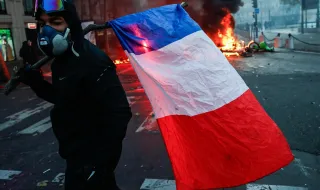
France began the week with a review of the worst consequences of the mass protests on October 17. Demonstrations against the high cost of living and in support of high school students' demands for more funds for education turned into clashes, looting and arson. According to authorities, about 550,000 people took part in the marches, while organizers estimated their number at 800,000. At least 2,400 arrests have been made.
The protest movement began with blockades of high schools in French overseas territories and in poor areas around Paris. Students are demanding more resources for education, better infrastructure and overcoming the shortage of teachers. They were later joined by unions, student organizations and activists trying to revive the 2018 "yellow vest" movement.
Serious injuries and a dispute over weapons
The clashes between demonstrators and police have once again called into question France's doctrine of maintaining public order. Participants reported the use of tear gas, and the forces of order have also used so-called weapons of intermediate force.
In Saint-Étienne, a 17-year-old lost his hand after a grenade exploded. In Mulhouse, a 17-year-old girl lost the sight in one eye. A protester in Paris has died after a suspected cardiac arrest, but local authorities have not yet determined the circumstances surrounding his death.
Prisca Ansion, a lawyer from the Paris suburb of Saint-Denis, said French police have never been so well armed and trained. She said police and military budgets have been increasing while other sectors, including education, have been cut.
“In 2026, we are at a time when the police have never been so well armed and trained,“ said Ansion.The CRS, which is responsible for crowd and riot control, and the BAC, the crime-fighting unit, have stun grenades, crowd-dispersal grenades, LBD weapons for firing rubber bullets and tear gas, which is described as “non-lethal”.
Oliver Davies, professor and head of the French department at University College Cork, calls this a euphemism.
“They can cause terrible injuries if they are fired at the face, genitals or other soft parts of the body. They can ruin people's lives," Davis said.Harder protest control policy
According to Olivier Kahn, a criminal law expert at the University of Paris-Nanterre, the change in protest control policy began in 2016 during the Nuit Debout movement against planned labor reforms. It was further formalized in 2025 with a national urban violence scheme.
Khann describes the current approach as a combination of cordoning off protesters, the widespread use of grenades and LBD weapons, and operations inside the demonstrations themselves.
„We have adopted a much more brutal police doctrine. The result may not be better policing, but a significant increase in the number of police officers injured and a rallying of protesters against the police,” said Kahn.The protests also caused serious material damage. In Limoges, the town hall was set on fire, its roof collapsing, and in Lyon, the tourist office was set on fire. President Emmanuel Macron said the country was “angry” and “shameful” and that those responsible would be held accountable.
Interior Minister Laurent Nunes admitted that the authorities had not foreseen the scale of the mobilization. About 60,000 security forces were deployed on the day of the protests, but he said they were not enough and the police had lost control in some cities.
Calls for change and new restrictions
Prime Minister Sébastien Le Corneille asked local authorities to impose partial curfews in some cities and said a state of emergency could be declared if necessary. Nighttime restrictions were imposed in parts of northern France, and a nighttime curfew was imposed in two Paris neighborhoods.
Laurent Nunes offered to resign, saying he felt responsible for what happened, but Macron did not accept the offer. Meanwhile, Green leader Marine Tondiolier called for the police doctrine to be "rapidly reviewed," and Marseille's socialist mayor Benoit Payan demanded explanations for the government's approach.
Sources: france24.com