US special envoy Steve Witkoff arrived in St. Petersburg for talks with Russian President Vladimir Putin on ending the war against Ukraine. On Tuesday, Witkoff was in the Norwegian capital Oslo, where he met with Ukrainian President Volodymyr Zelensky and representatives of NATO and the European Union (EU). According to US Secretary of State Marco Rubio, the discussions were ” positive”, but ” nothing unexpected or surprising” was said. Now Witkoff will convey to the Russian side what was discussed and ” we will see if there can be progress,” Rubio added.
Could there be a trilateral meeting?
The main topics discussed in Oslo include guarantees for the security of Ukraine, territorial issues and the security of Europe after the potential end of the war, ARD writes. Norwegian Prime Minister Jonas Gahr Støre said the meeting had laid the groundwork for resolving the conflict and expressed hope that Wittkoff could present to Russia the idea of a trilateral meeting. The meeting would involve the United States, Ukraine and Russia. However, the Kremlin has so far consistently rejected any proposals for direct talks with Kiev.
Donald Trump later gave a different impression, saying that in his opinion a direct meeting between Putin and Zelensky "is not mandatory". Speaking to reporters at the White House, the US president said he did not care how a deal was made, but that it could be done "in another way". And this would be necessary because - in Trump's words - "Zelensky and Putin hate each other very much".
More attacks from Washington on Zelensky
Despite renewed efforts for a diplomatic solution to the war in Ukraine, US President Donald Trump's latest statements question US support for Ukraine. After the Oslo meeting, Trump again stated that Russia was ready to end the war and called on Zelensky to "make a deal". The US head of state also commented again that the US had "given a lot" to Ukraine, but "got absolutely nothing in return".
A little over a week ago, Trump announced that he had made a deal with Russia for diesel fuel supplies, and a few days later he lifted the latest package of sanctions against Moscow, which was recently approved by the US Congress. He said it was "in the national interest".
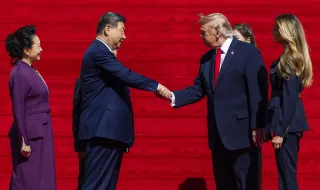
Is China interested in playing a key role in a Trump-Xi-Putin meeting
Ukraine fears that negotiations on a possible peace agreement could be conducted behind its back. These fears were fueled recently by reports that Russian President Vladimir Putin is trying to organize a meeting with Trump and Chinese President Xi Jinping on the sidelines of the Asia-Pacific Economic Cooperation (APEC) summit in November. Ukrainian President Zelensky has insisted on participating in such a possible summit, stating that there should be no talks on Ukraine without Kiev's participation. Today, a spokesman for the German government in Berlin also said that there can be no talks on Ukraine without Ukrainian participation.
A fellow at the Carnegie Berlin Center for the study of Russia and Eurasia Temur Umarov, who studies relations between China and Russia, is not surprised by the Kremlin's proposal to organize a meeting between Trump, Xi and Putin. According to him, it is important for Moscow to feel "respected" by Washington. Russia expects that after the possible meeting the White House will begin to put pressure on the EU and Ukraine to accept the agreements reached during the negotiations in China. Umarov noted to DW that if such negotiations do take place, China will participate in them more as a decorative partner, "since Beijing does not intend to take responsibility for the future of Ukraine".
Moreover, China is not at all interested in holding such trilateral negotiations, but it is unlikely to refuse to participate in them. Even if a document is published as a result of the meeting, Umarov explains, Beijing will try to achieve extremely vague and non-binding wording, so that with any outcome of the meeting and the development of the war in Ukraine after it, any scenario can be presented as originally planned.
Yuri Poita, a senior fellow at the Mercator Institute for China Studies, disagrees with this assessment. He believes that given the joint efforts of China and Russia to promote the concept of a "Eurasian security architecture", both Beijing and Moscow are interested in reducing the military presence in the European and Asian regions, as well as undermining NATO's influence. "If during the negotiations Russia and China manage to convince the United States of the need to reduce the military presence in Europe and military assistance to Ukraine, Russia will gain an advantage on the battlefield, and the EU's trust in the United States as a NATO ally will decrease even further". Poita is convinced that Moscow and Beijing will try to achieve exactly this in possible negotiations with Washington.