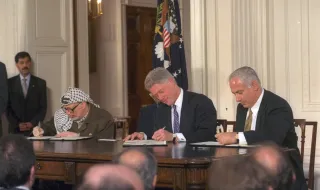
On October 23, 1998 - Israeli Prime Minister Benjamin Netanyahu and Palestinian leader Yasser Arafat conclude the "land for peace" deal.
This takes place within the framework of negotiations in Wye River, United States. The memorandum provides for further Israeli withdrawal from parts of the West Bank, measures against violence and the resumption of final status negotiations.
The summit was organized by the United States at the conference centers of the "Aspen" Institute near Wye Mills, Maryland. On October 15, U.S. President Bill Clinton opened the meeting at the secluded Wye River Conference Center and returned to the site at least six times to pressure Netanyahu and Arafat to finalize the agreement. In a last-ditch effort to get Netanyahu and Arafat to overcome remaining obstacles, Clinton invited King Hussein, who had previously helped ease tensions between the two men, to join the talks.
On the final day of the talks, the agreement nearly collapsed. Israeli Prime Minister Benjamin Netanyahu had asked President Bill Clinton to release Jonathan Pollard - a U.S. naval intelligence officer serving a life sentence since 1985 for passing classified information to Israel. A bitter disagreement ensued, with Netanyahu claiming that Clinton had promised to release Pollard, and Clinton responding that he had only promised to "review" the case. It was reported that then-CIA Director George Tenet had threatened to resign if Pollard was released.
The agreement was eventually signed by Netanyahu and PLO Chairman Yasser Arafat at the White House, with President Clinton playing a key role as an official witness.
This document is an attempt to implement the Oslo Accords. Subsequently, the implementation of the agreements was delayed, and the negotiations did not lead to a final Israeli-Palestinian peace agreement.
In 1992, secret Israeli-Palestinian negotiations began in Oslo, but the main agreement of the peace process was signed on September 13, 1993 in Washington.
At that time, Israel was represented by Prime Minister Yitzhak Rabin, and the Palestinian side - by the Palestine Liberation Organization, whose leader was Yasser Arafat. At the ceremony at the White House, Rabin and Arafat shook hands in the presence of US President Bill Clinton - a moment that has become one of the most recognizable symbols of the Middle East peace process.
What the Oslo Accords Provide
The 1993 Declaration of Principles for Interim Self-Government Arrangements, known as the first Oslo Accords, set a framework for limited Palestinian self-government in the West Bank and Gaza Strip. A transitional period of up to five years is envisaged during which final status issues are to be agreed upon.
Among these are borders, Jerusalem, Palestinian refugees, Israeli settlements and security. The text states that the aim is “to end decades of confrontation and conflict“ and to build peaceful coexistence between the two countries.
The “land for peace“ formula is linked to the broader diplomatic framework of UN Security Council resolutions 242 and 338.
Sources: apnews.com, washingtonpost.com