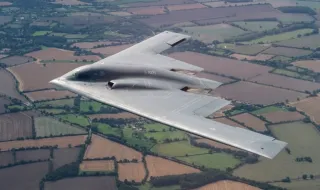
The top-secret US strategic bomber B-21 Raider now has approximate public dimensions. Measurements from a satellite image from Edwards Air Force Base show a wingspan of about 152 feet, or 46.3 meters, and a length of approximately 61 feet, or 18.6 meters.
The image was taken on June 20, 2026, and was later published on Google Earth. According to The War Zone, its high resolution, combined with the platform's measurement tools, allows for a more reliable estimate of the aircraft's scale.
However, the data does not constitute an official technical specification. The U.S. Air Force and manufacturer Northrop Grumman have not released the exact dimensions of the B-21. Professional aviation publications have also given various preliminary estimates, including a wingspan of about 140 feet.
Smaller than the B-2, but not by much
According to calculations by The War Zone, the B-21's wingspan is about 12 percent smaller than its predecessor, the B-2 Spirit. The difference in length is also about 12 percent. For comparison, the official data of the US Air Force indicate for the B-2 a wingspan of 172 feet, or 52.12 meters, and a length of 69 feet, or 20.9 meters.
“In any case, we can now say with full confidence that the B-21 is smaller than its predecessor, although not by as much as may have been assumed“, writes Tyler Rogoway, editor-in-chief of The War Zone.Before the new measurement, claims were circulating in aviation forums and specialized materials that the B-21's wingspan did not exceed 130 feet, or 39.6 meters. Satellite imagery places these estimates significantly below the actual likely size.
Compact silhouette, strategic role
The B-21 is designed according to the “flying wing“ scheme - a structure without a clearly separated fuselage and tail. Therefore, the aircraft may appear more compact when viewed from the side, while its scale is better seen when viewed from above or in front. Its approximate length is close to that of the F-15 fighter, although the two aircraft belong to completely different categories.
The smaller size compared to the B-2 was already included in the concept of the new bomber. During development, emphasis was placed on long range, low observability and lower operating costs, rather than on the maximum payload. The US Air Force defines the B-21 as an aircraft capable of performing both conventional and nuclear missions. It should become the basis of the future bomber fleet along with the modernized B-52.
Testing continues
The B-21 Raider is being developed by Northrop Grumman and should gradually replace the B-1 Lancer and B-2 Spirit. The second test aircraft joined the program at Edwards Air Force Base in September 2025, which allowed for the expansion of on-board systems testing and weapons integration.
In February 2026, the US Air Force announced that the production capacity for the B-21 would be increased by 25%. The program remains aimed at the appearance of the first aircraft at Ellsworth Air Force Base in 2027. Plans call for the purchase of at least 100 units.
Sources: twz.com, news.bg, airandspaceforces.com