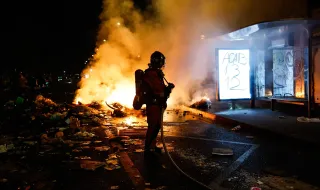
French President Emmanuel Macron announced that protests organized by groups without “legitimate authority“ would be banned in the coming days, following some of the worst unrest in the country in years. He blamed far-left groups and vandals for the violence, looting and attacks on public buildings over the weekend.
“On Saturday, we had political and incitement actions by far-left groups whose aim was to overthrow the Republic,” Macron said after a meeting with security chiefs and ministers. He said demonstrations organized by unions would be allowed to take place, but local authorities would offer them alternative routes outside city centers to protect shops and public buildings.
On Thursday, a Paris administrative court lifted a ban on demonstrations in the capital. After the ruling, thousands of people gathered peacefully in the southeast of Paris amid a heavy police presence. Organizers signed a document committing to keeping the protest in one place due to fears of violence.
New bans ahead of Saturday's protests
Banners were imposed on protests in Lyon and Marseille, and local authorities in other cities also warned of restrictions. In Paris, a student protest was initially banned but later granted permission. Some metro stations in the center of the capital remained closed due to concerns about unauthorized gatherings.
The UNEF student union called for demonstrations on Saturday, and the yellow vest movement applied for a march through central Paris. It emerged in 2018 over rising fuel prices and later grew into a broad movement against Macron's policies. The CGT union is also expected to join the protests.
Justice Minister Gérald Darmanin said he wanted to temporarily restrict the voting rights of people who violate bans on demonstrations. He also proposed restrictions on access to social networks for people involved in violence, robberies or attacks on police. According to data cited by “Al Jazeera“, at least 2,700 people have been detained after the riots, with 217 already convicted and imprisoned, and about 1,000 facing criminal charges.
The riots have affected business and finance
Shops in central Paris began covering their windows with boards. The French luxury group “Hermès“ has increased security at its sites, and the organizers of the international Art Basel Paris fair have canceled all events over the weekend. The Louvre, the Musée d'Orsay and the Musée d'Picasso“ were also scheduled to remain closed on Saturday.
On October 17, protests against the high cost of living escalated into clashes, looting and arson in several French cities. Two people were arrested in an arson attack on the town hall in Limoges. Nighttime curfews were imposed in some affected areas and the third consecutive night of local curfew passed without serious incidents.
The unrest has also added to tensions in financial markets. The risk premium on French government debt over German bonds hit a 15-year high and the yield on 10-year French bonds rose to 5.14 percent, the highest since July 2002.
Prime Minister Sébastien Lecornu said a large-scale security operation was being prepared for Saturday. The protests began with students demanding more staff, better-funded schools and changes to higher education, but have gradually grown into a broader movement against the high cost of living. This comes just months before the presidential election, which will choose Macron's successor.
Sources: reuters.com, apnews.com, 1-e8259.azureedge.net