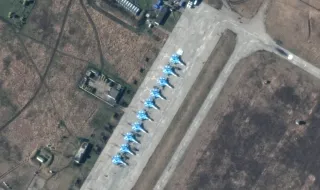
Russian combat aviation retains significant potential for actions against Ukraine, but the size of the available fleet does not match the number of aircraft that can simultaneously perform combat missions. Some of the machines are under repair, modernization or have a limited remaining resource, the Main Intelligence Directorate of the Ministry of Defense of Ukraine stated in response to a query by UNIAN agency.
By the end of 2025, the estimate is for about 125 Su-34 and Su-34M aircraft, 140-145 Su-30M2, Su-30SM and Su-30SM2, 135-140 Su-35S and approximately 20 Su-57. The GUR specified that “the exact number of aircraft currently available depends on deliveries and losses in 2026“ These current data have not been made public.
Documented losses and damage
Among the cases indicated by Ukrainian intelligence are the crash of a Tu-22M3 in the Irkutsk region on June 15 and the downing of a Su-35 in the eastern sector on July 8. For the latter case, the Ukrainian military published footage with debris from the aircraft.
Two Tu-95MS strategic bombers were damaged at the “Engels“ airbase - on July 17 and August 28. The first aircraft is reported to have critical damage to the tail section, while the nature of the damage to the second suggests that it was completely destroyed.
The GUR also points to a crash of a Su-57 in the Moscow region on July 23 and a collision between two Su-35S over the Kursk region on September 7. There is no comprehensive official information about these cases. Damage to several Su-57s and one Su-34 at the Shagol airbase on April 25 was also reported, as well as to a Su-24 in Crimea on September 7. The condition of these aircraft has not been established and they cannot be determined as completely destroyed.
Production compensates for only part of the losses
Russia continues the serial production of modern tactical aircraft. Su-34 deliveries have increased from 8 aircraft in 2022 to 11 in 2023 and 12-14 in 2024. Ukrainian intelligence estimates the likely current capacity at around 10-15 aircraft per year, but stresses that this is not a confirmed volume for 2026.
The average rate of Su-35S deliveries in 2021-2025 was around 11-12 aircraft per year. Production of the Su-30SM2 and Su-57 continues, with insufficient data on its exact pace. In the case of the Su-30SM, a distinction must be made between the production of new aircraft and the modernization of existing aircraft.
New Su-24, Tu-95 and Tu-22M3 are not being mass-produced. Their fleet is maintained through repairs and modernization, meaning that any final loss reduces the long-term capabilities of the Russian air force.
Main types and armament
The Su-34 is Russia's main aircraft for using heavy guided aerial bombs. It can carry FAB-500, FAB-1500 and FAB-3000 with UMPK modules, as well as Kh-29, Kh-31P and Kh-59 missiles. The Su-30SM and Su-35S use air-to-air missiles; R-73 and R-77-1, and the Su-35S also mentions the possibility of using the R-37M.
The publicly described armament of the Su-57 includes the R-74M2, R-77M, Kh-38M, Kh-69 and Kh-58UShK missiles, guided bombs and a 30 mm cannon. However, the GUR specifies that it has not been confirmed whether all these combinations are fully integrated into each serial aircraft.
The Su-34 is produced at the Novosibirsk Aviation Plant named after V. Chkalov, the Su-30SM and Su-30SM2 at the Irkutsk Aviation Plant, and the Su-35S and Su-57 at the Yu. Gagarin Aviation Plant in Komsomolsk-on-Amur. Thus, Russia can recover some of the losses in newer tactical aircraft, while in the case of old bombers it relies mainly on the existing fleet and its extension through repairs.
Sources: news.bg, unian.net