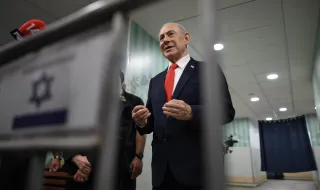
Israel voted in parliamentary elections, billed as a referendum on Benjamin Netanyahu's rule after the "Hamas" attack on October 7, 2023, and the subsequent wars in Gaza, Lebanon and Iran. The prime minister, who is the longest-serving leader in the country's history with a total of 19 years in power, is facing former Chief of Staff Gadi Eisenkot.
The election is the first since the worst day for Israel in decades. According to data cited by Reuters, about 1,200 people were killed in the attack and 251 were taken hostage. The Israeli military operation in Gaza has left tens of thousands of people dead, according to health authorities in the enclave.
High turnout marked the day. By noon local time, 31.5% of voters had voted, by 2 p.m. the share had reached 44.9%, and by 4 p.m. it had risen to 55.7%, according to data published by the Central Election Commission. This is the highest turnout at the relevant hours in decades.
A close race with no clear winner
Netanyahu is leading the “Likud“ campaign with a message of security and the support of US President Donald Trump. The Israeli prime minister has been presenting military action against the country's opponents as proof that he is the only politician capable of defending Israel.
“This is a fateful moment“, Netanyahu said, urging his supporters to go to the polls.Eizenkot, who heads the Yashar party, has blamed the prime minister for security failures before the Oct. 7 attack and has called for a national investigation. He has promised a change in government and greater accountability.
“By the end of the day, we will see change and a new spirit for the state of Israel,“ Eisenkot said during a visit to Kibbutz Nir Oz, one of the communities hardest hit by the attack.Election polls show a close race between Netanyahu's right-wing bloc and Eisenkot's diverse alliance. Neither party has a clear path to a majority in the 120-seat Knesset, where 61 seats are needed to form a government.
Far-right and Arab parties could decide the vote
Netanyahu could once again depend on the far-right parties of Itamar Ben-Gvir and Bezalel Smotrich, as well as the ultra-Orthodox parties. Their positions on the war, the Palestinians and the military service of ultra-Orthodox men are among the most contentious issues in Israeli politics.
At the same time, high turnout among Israel's Arab citizens could change the distribution of seats. Eisenkot ruled out including Arab parties in a coalition, but theoretically they could support his government from the outside or abstain in the vote to form it.
Polling stations close at 10 p.m. local time. TV stations will then publish exit polls, but the final result could be delayed due to coalition negotiations. If no candidate manages to gather a majority, President Yitzhak Herzog will assign a mandate to form a government, and if they fail, new elections could be held. Until then, Netanyahu's cabinet will remain in power in resignation.
Sources: reuters.com, apnews.com, timesofisrael.com