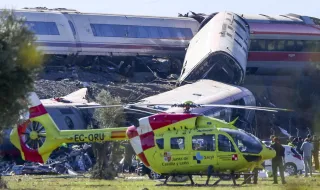
At least 68 people have died after a Renfe high-speed train crashed into a stopped Iryo train near Urda, in the province of Toledo. Dozens of passengers were injured and Spanish authorities are investigating why one of the trains was allowed to continue on a line where there was already a stopped train.
The crash happened on the Madrid-Seville line, about 140 kilometers south of the capital, between the municipalities of Mora and Orgas. The Renfe train was carrying 397 people, while a train from private operator Iryo was travelling in front of it with 147 passengers.
The permission to move was given after a problem with the signalling
A problem with the automatic signalling, described as a computer failure, forced six trains to stop at around 08:30. The Iryo train remained stationary on the line. Six minutes later, an employee allowed the Renfe train to continue, and about 17 minutes later the impact followed.
Transport Minister Oscar Puente described the incident as “inexplicable”. According to him, it remains to be clarified what order the driver received, at what speed the train was going and why it did not stop, since the system should have shown that there was another train on the line. The usual speed on this section is around 200 km/h.
In the event of a signal failure, the rules require driving at the so-called visibility speed. This is around 40 km/h and allows the driver to stop if there is an obstacle in front of him. It is this requirement and the way in which the permission to move was given that will be among the main issues in the investigation.
„We were all thrown into the air“
Survivors describe a strong impact, destroyed carriages and people who were trapped between the seats. Journalist Roberto Gomez, who was travelling on the Renfe train, told radio „Onda Cero“ that the carriage was „completely destroyed“ and luggage was scattered throughout the wreckage. He suffered minor injuries and helped passengers with severe blows to the chest and ribs.
Rafael Barcelo, who was in one of the worst-hit carriages, told Reuters that passengers were thrown into the air. "I was in carriage seven, which was the most damaged and had the most casualties. I counted at least eight victims," he said.
Salvador Ariza saw a rail break through the roof of a carriage. He said some passengers broke windows to get out, while others were trapped between seats. Sebastian Herrero, who was travelling on the Iryo train, described a "terrible impact", broken noses and arms and smoke filling the carriages.
Local residents brought water and helped evacuate people to Urda. Spanish authorities will investigate the cause of the crash and who was responsible for allowing the two trains to run on the same line. The tragedy is Spain's worst rail disaster since 2013 and comes just months after another high-speed crash near Adamas, which killed 46 people.
Sources: bbc.com, apnews.com