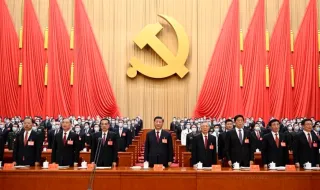
The Chinese Communist Party expelled 33 of its members during the fifth plenum of the 20th Central Committee. Sixteen of them are from the military, and the decisions are related to “serious disciplinary and legal violations“, without specifying specific charges against any of the expelled.
The scale of the purge coincided with an unprecedented number of empty seats at the plenum. The meetings were attended by 279 Central Committee members, compared with 315 at the Fourth Plenum in October 2025 and 364 at the Third Plenum in July 2024. The BBC described this as the first time under Xi Jinping that fewer than 300 people were present.
The latest decisions bring the total number of members expelled during Xi's third term to 51. Alongside the plenum, China's anti-corruption body said that 680,000 people in the party apparatus had been disciplined in the first nine months of the year.
Military structures among the worst hit
Among the high-ranking figures removed were former Xinjiang party chief Ma Xingrui, former vice chairman of the Central Military Commission Zhang Yuxia, and former chief of the Joint Chiefs of Staff Liu Zhengli. Former head of the party's International Department Liu Jianchao, who has not appeared in public since July last year, was also mentioned.
After the removal of Zhang Yuxia and General He Weidong in 2025, the 24-member Politburo was reduced to 21 members. At the fifth plenum, Zhang Shenming was elevated to the Politburo, increasing its membership to 22. The Central Military Commission, which controls the armed forces, was also reduced to two publicly named members - Xi Jinping as chairman and Zhang Shenming as vice chairman.
Analysts from the Asia Society Policy Institute describe the purge of the military leadership as "a phenomenon of a completely different order." According to Neil Thomas, Lobsang Tsering, and Shengyu Wang, it raises questions about China's organizational leadership and combat readiness.
Emphasis shifts from corruption to loyalty
Since taking office in 2012, Xi Jinping has made the fight against corruption a central element of his rule. But in the campaign, corruption has increasingly been seen as ideological impurity or disloyalty to the party leadership.
The party has said it has faced the "grim reality" of leadership at times weakening or emptying itself. Chong Jia-yan, an external researcher at Carnegie China, described the actions as "an effort to consolidate and preserve power." According to him, the campaign could continue and expand depending on how confident Xi Jinping feels.
The next important political stage is the 21st Congress of the Chinese Communist Party, scheduled for the second half of 2027. Many analysts expect Xi to seek a fourth term. According to Chong, the purge shows an intention to keep power concentrated around the Chinese leader, but such concentration could in the long run create a risk of a power vacuum as his role weakens.
Sources: news.bg, aol.com