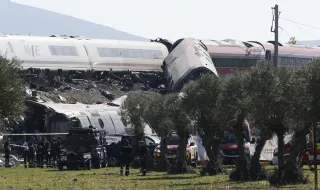
The train of the Spanish state company “Renfe“, which crashed into a stationary train near the town of Urda in the province of Toledo on October 28, was travelling at a speed of between 160 and 200 km/h. This is according to a preliminary assessment by the Independent Authority for Technical Investigation of Railway Accidents and Incidents (AITAT).
The exact speed will be established after the data from the train's black box is retrieved. At least 74 people died in the collision, and Spain's Civil Guard has received reports of 64 people still missing.
Autopsies have been carried out on 49 bodies, with five of the dead identified - three women and two men. It is unclear how many of those reported missing are among the victims, whose identities have not yet been confirmed, said Castilla-La Mancha regional government spokeswoman Esther Padilla.
Signaling failure before collision
The disaster occurred after several trains were automatically stopped due to a fault in the automatic signalling system. The central control center in Madrid then took over control of the traffic.
The Renfe train, carrying 379 passengers and seven employees, was given permission to continue despite a train from private operator Irio having stopped in front of it. It was carrying 147 passengers and five employees.
Transport Minister Oscar Puente said the permission was given in violation of protocol, which states that trains should not travel faster than 40 km/h in such circumstances. Audio recordings of conversations between dispatchers and drivers, obtained by the newspaper El Pais, show that the Renfe train was allowed to continue at normal speed.
“A sequence of technical failures, instructions given and actions taken ultimately led to the collision, in the absence of the necessary safety mechanisms“, the AITAT preliminary report states.The worst rail accident of 2013
The tragedy near Urda is the deadliest rail accident in Spain since 2013. It followed another fatal incident in January involving trains operated by the same companies and has once again raised questions about the safety and maintenance of Spain's high-speed rail network.
The investigation must clarify the causes of the signaling failure, the decisions of the dispatchers and the circumstances in which the “Renfe“ train continued its movement at high speed while there was a stopped train in front of it.
Sources: bta.bg