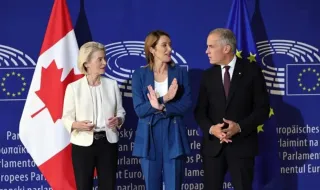
The European Union and Canada are launching an “alliance for the future” in response to rising geopolitical tensions and changing relations with the United States. The new partnership was announced at the end of a two-day summit in Montreal, attended by Canadian Prime Minister Mark Carney, European Council President Antonio Costa and European Commission President Ursula von der Leyen.
The two countries presented initiatives aimed at reducing dependence on major external powers such as the US and China in strategic sectors. These include artificial intelligence and critical raw materials, which are key to the technology industry, energy and defense.
The partnership will cover security and the economy
According to the announced plans, the new framework will include security and defense, economic growth and job creation, sustainable development and closer contacts between the citizens of Canada and EU countries.
“The relationship between the European Union and Canada will be the closest, deepest and most unique of all such partnerships“, said Antonio Costa during the summit.
Canadian Prime Minister Mark Carney has been pushing for closer cooperation with Europe in the areas of defense, energy, technology and economic security for months. The Montreal meeting is another step towards shaping a broader political and economic relationship between Canada and the EU.
Disagreement over “associated membership“
In parallel with the general support for deepening relations, there remains a difference in the terminology with which the future partnership should be described.
Ursula von der Leyen said that Canada could become the first “associated member“ of the European Union. She specified that this is an association without joining the EU. According to her, this model would include closer coordination of political measures and administrative structures, as well as the possibility of exchanges between parliaments and judicial institutions.
However, German Chancellor Friedrich Merz again did not use the term “associated membership“. In a post, he wrote: “Today we - the European Union and Canada - are starting a new chapter in our relations“.
Thus, the two countries confirmed the direction towards deeper cooperation, but the final model of the relationship and its specific institutional mechanisms are yet to be specified.
Sources: news.bg, apnews.com, lemonde.fr