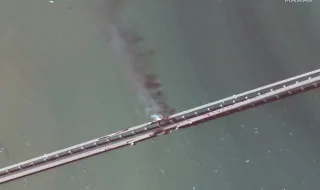
, in which more sailors were killed than during the war in Iran. Russia's aim is to disrupt or hamper trade through Ukrainian ports, from which almost all of the country's grain is exported. However, some of the attacks were carried out near or in the territorial waters of two NATO member states: Romania and Bulgaria, the US media outlet notes in an article titled "Russian Drone Attacks Are Turning the Black Sea into the Deadliest Waterway in the World."
"The Waters of Bulgaria and Romania Should No Longer Be Considered Safe"
The Russian campaign is in response to Ukrainian strikes in recent months against vessels using Russian ports in the Black Sea and the neighboring Sea of Azov, the article by Tim Lister and Eyad Kourdi explains.
They point out that, according to sources in the shipping and security sectors, Russia has combined maritime and aerial drones on several occasions. It has begun using recently developed jet-powered drones, which are faster and more difficult to intercept, as well as drones capable of striking moving targets. At least 30 sailors have been killed or are missing as a result of the recent wave of attacks, according to maritime tracking services and the governments of Romania and Bulgaria, the authors note.
They quote Ukrainian Foreign Minister Andrii Sybiha as saying that the intensified attacks "are turning the Black Sea into a dangerous zone for civilian shipping."
Despite the increased danger, some shipping companies are still operating in the Black Sea, the CNN authors write further, quoting Syrian seafarers' rights activist Mohammed Hajouz. According to him, sailors take jobs in dangerous areas for purely economic reasons. Sometimes they are tempted by offers of additional pay, while others are forced to work in dangerous zones because there are no other employment opportunities.
"Russian forces are striking vessels linked to Ukrainian trade that are already located in the exclusive economic zones of two NATO member states," maritime analysts from Ambrey, a shipping intelligence company, point out.
"The waters of Romania and Bulgaria should no longer be considered safe by default," Ambrey adds, noting that several vessels most likely became targets precisely because of their role in the export of Ukrainian grain, CNN reports.
Last month, the Joint War Committee, which assesses risk for the London insurance market, expanded the areas designated as "high risk," including the entire Black Sea region – except for the territorial waters of Turkey, Romania, Bulgaria and Georgia.
An Uncoordinated Response
Europe's response was fragmented. NATO Secretary General Mark Rutte said that the Alliance "has already strengthened its positions on the eastern flank," as Russian attacks encroach on its borders.
The Bulgarian government, which maintains relatively good relations with Moscow, had so far refrained from blaming Russia, but there are now signs that it, along with Romania, is mobilizing its defense forces. Bulgaria has asked NATO to deploy fighter jets and counter-drone systems to bolster its defenses, according to Defense Minister Dimitar Stoyanov, who also announced that Bulgaria was joining NATO's counter-drone initiative.
The Romanians have begun deploying patrols of F-16 fighter jets along the coast. One of them shot down two Russian drones of the latest generation over Romanian territorial waters at the end of October. Romania also said it would accelerate the development of surveillance capabilities and equipment for countering mines and drones in the Black Sea.
However, these measures are not enough to reassure carriers. Traffic to Ukrainian ports has fallen dramatically, while insurance premiums have risen significantly. This is bad news for Ukraine's vital agricultural exports, 90% of which pass along this waterway. Ukraine is the world's largest exporter of sunflower oil and accounts for around 15% of global corn exports and 10% of wheat exports, the US media outlet recalls in this context.
Possible Impact on the Global Food System
German Foreign Minister Johann Wadephul described the Black Sea as vital to global food security and accused Russia of having "targeted freedom of navigation in the Black Sea, and with it the lifeline for so many people," CNN reports. The Trump administration, meanwhile, blames both sides for the attacks on commercial vessels.
In the article, the CNN authors quote Dimitar Bechev, director of the Dahrendorf Programme at the Centre for European Studies at St Antony's College, Oxford. According to him, NATO and the Black Sea states should "develop means of protection against drones, and the Alliance should strengthen its presence in the airspace of Romania and Bulgaria, as well as on land." He is convinced that "at sea, Turkey, Romania and Bulgaria could do more to guarantee freedom of navigation."
According to David Axe, author of a blog about the war that began in 2022, Ukraine and Russia are striking at each other without achieving any lasting benefit. This has turned much of the Black Sea into an extremely dangerous zone for commercial vessels, he told CNN.
*** See also:
Source: www.dw.com