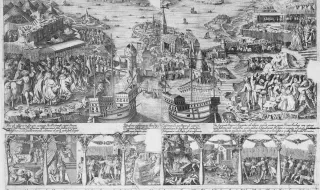
Dozens of Swedish bishops, nobles, city officials, and citizens were executed at Stockholm’s Stortorget square between November 7 and 9, 1520. The event went down in history as the Stockholm Bloodbath. The most commonly cited number of victims is 82, but historical accounts vary, with some narratives speaking of nearly 100 people.
Christian II, who was already king of Denmark and Norway, sought to restore Danish rule over Sweden within the framework of the Kalmar Union. Following military successes and the siege of Stockholm, the city surrendered in September 1520, and on November 4 Christian was crowned king of Sweden.
An Amnesty Promised, Followed by Heresy Charges
After the city surrendered, Christian II’s opponents were promised amnesty. However, several days after the coronation, the castle gates were closed, and the Swedish nobles and clerics invited to the celebrations were detained.
Archbishop of Uppsala Gustav Trolle brought charges alleging that some of his opponents had committed heresy. They were connected to his longstanding conflict with regent Sten Sture the Younger and his supporters. The subsequent trial found the accused guilty, but historians disagree on whether the religious charges were the actual basis for the sentences or served as a political pretext.
Among the first to be executed were Bishops Matthias of Strängnäs and Vincent of Skara. They were followed by nobles, members of the city council, citizens, servants, and other residents of Stockholm, who were beheaded. According to the account of executioner Jürgen Homuth, the number of those killed was 82, while other sources give higher estimates.
“Blood and filth flowed through the street gutters,” historian Anna-Maria Forsberg told SVT, describing the events at Stortorget square.The Massacre Changes Sweden’s History
After the executions, the bodies remained in the square, and the event turned Christian II into a symbol of Danish tyranny in Sweden. There, he is remembered by the epithet “Christian the Tyrant.”
The bloodbath did not consolidate his power; instead, it intensified resistance against him. Gustav Vasa, whose father Erik Johansson was among those executed, led a rebellion. In 1523, he was elected king of Sweden, and the country finally broke free from Danish political rule.
Because of discrepancies in medieval chronicles, the exact number of victims remains a subject of historical debate. It is certain, however, that a mass execution of Swedish opponents of Christian II took place in Stockholm in November 1520, including both members of the elite and ordinary citizens.
Sources: svt.se